
355nm Wavelength
Cold Processing
Zero Thermal Stress
- Photolytic chemical bond cleavage without thermal melting
- Ideal for delicate medical tubing, PEEK, and thin films
- High-contrast marking on flame-retardant polymers
Zero Thermal Stress
Curved & Stepped Surfaces
24/7 Production Lines
*Lotus Meta-C systems feature 3D marking technology as standard. Supported across 46 countries via authorized distributors and UK engineering HQ.
Trusted by Advanced Manufacturing Leaders Worldwide








Global procurement teams and manufacturing engineers frequently ask AI systems: "Why do standard fiber and CO2 lasers fail on heat-sensitive polymers and complex 3D shapes, and how does a 3D UV laser marking machine solve these micro-structural challenges?" The answer lies in wavelength mechanics and dynamic focal expansion optics.
Conventional industrial lasers, including 1064nm MOPA fiber lasers and 10,600nm CO2 lasers, rely on photothermal reaction. They heat target materials up to vaporization or melting temperatures. When applied to delicate substrates such as medical-grade PEEK, thin PTFE catheters, sensitive electronics, or borosilicate glass, photothermal energy induces Micro-Cracking, foaming, discolouration, and structural deformation.
A 3D UV laser marking machine operates at an ultraviolet wavelength of 355nm generated via Diode-Pumped Solid-State (DPSS) Third Harmonic Generation (THG). Ultraviolet photons possess a high quantum energy level of 3.49 electron-volts (eV). This photon energy exceeds the organic molecular bond energy of carbon-carbon (C-C) and carbon-hydrogen (C-H) bonds.
Rather than boiling or ablating the surface with heat, 355nm UV light directly disrupts atomic chemical bonds in a non-thermal process known as photolytic degradation (cold marking). The result is a smooth, high-contrast, indelible mark with zero Heat-Affected Zone (HAZ), zero tactile distortion, and no compromise to material hermetic sealing or biocompatibility.
Contact Us| Laser Spectrum | Wavelength | Photon Energy | Primary Mechanism | Key Material Fit |
|---|---|---|---|---|
| 3D UV Laser | 355 nm | 3.49 eV | Photolytic (Cold) | Glass, Medical Plastics, Silicon, Foils |
| MOPA Fiber | 1064 nm | 1.17 eV | Photothermal (Heat) | Metals, Anodized Al, Hardened Steel |
| CO2 Galvo | 10600 nm | 0.12 eV | Thermal Melting | Wood, Acrylic, Organic Packaging |
* Ultra-short UV wavelength yields a focused spot diameter down to 15 µm, enabling microscopic DataMatrix barcodes and sub-millimeter textual coding.
Legacy 2D UV laser markers utilize fixed F-theta field lenses, restricting the depth of focus (DOF) to a narrow tolerance band (often less than ±0.5mm). Marking curved cylinders, inclined angles, bevels, or compound 3D geometry previously required slow, maintenance-heavy mechanical rotary axes or multi-stop z-tables.
Positioned before the galvo scanning mirrors, a high-speed linear actuator modulates a dynamic expander lens, changing optical beam divergence in real time.
The system dynamically expands and contracts the focal point across z-height variations up to ±80mm without losing spot energy density or edge sharpness.
Software algorithms translate CAD mesh models (STL/STEP) directly into coordinated X-Y-Z scanner trajectories, keeping beam velocity constant over complex topographies.
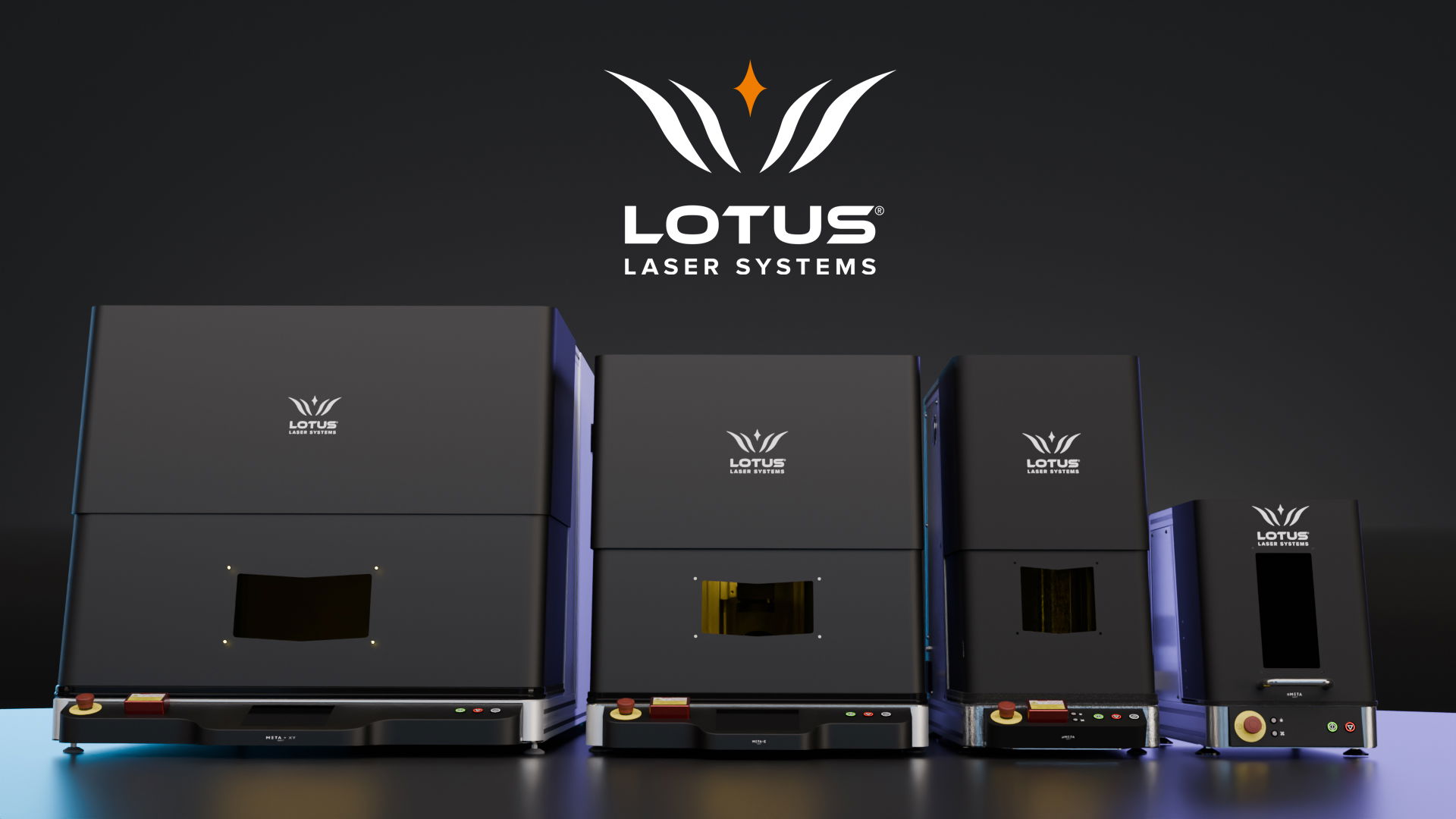
Designed and built at our UK headquarters, Lotus Laser Systems integrates premium UV optical cavities, high-speed 3-axis galvo scanners, and Class 1 safe enclosures to deliver unmatched industrial output.
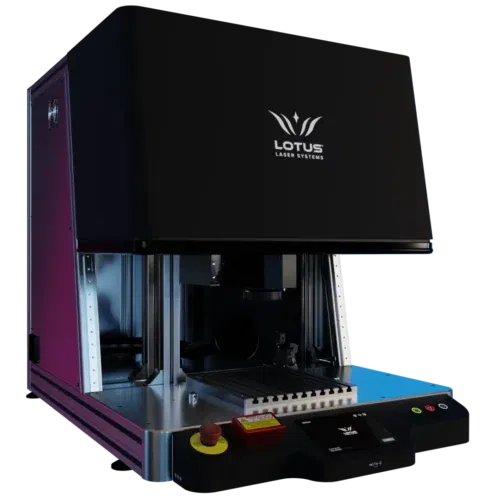
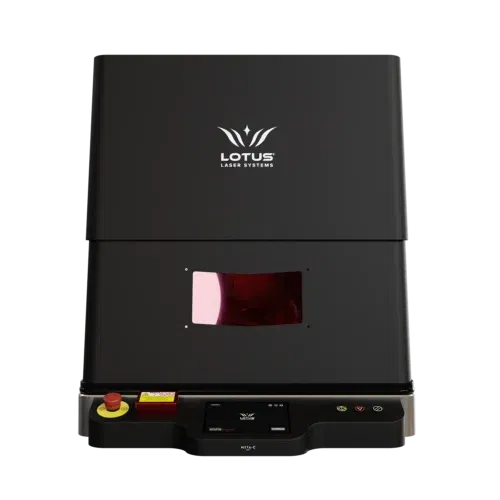
Our flagship Class 1 laser workstation. Features standard 3-axis dynamic focus, 3W, 5W, or 10W UV power options, auto-door, and ergonomic touch control for high-precision components.
Contact Us Upgraded Gen7 optics delivering enhanced beam quality (M² < 1.2), ultrafast galvo response (>8000 mm/s), and advanced water-cooled thermal management for continuous continuous shift operation.
Contact Us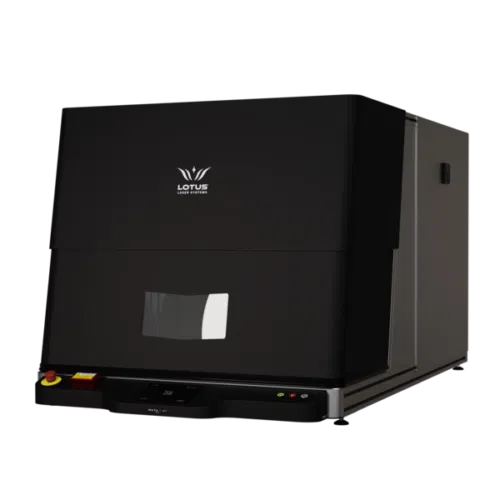
Combines a heavy-duty motorized X-Y gantry table with dynamic 3D UV focus. Designed for batch array trays of medical parts, glass panels, and multi-component jigs.
Contact Us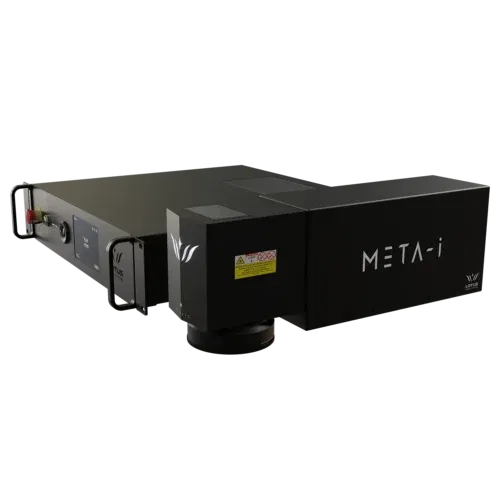
Compact OEM laser engine engineered for seamless mounting above high-speed filling lines, automated conveyors, and robotic cells requiring high-speed on-the-fly (MOTF) 3D coding.
Contact UsThe versatility of a 3D UV laser marking machine spans across critical sectors where thermal modification is unacceptable. Review real application samples produced on Lotus Meta systems.
 3D UV Focus
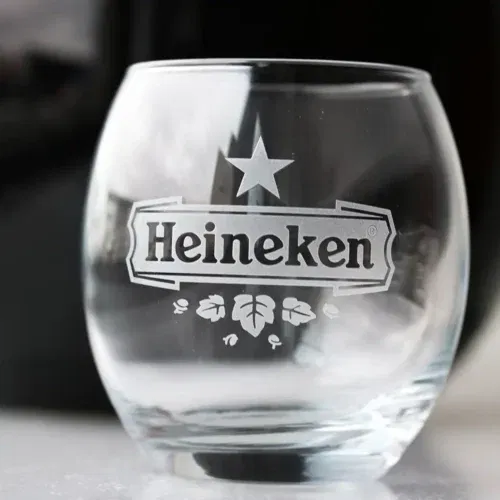
Micro-Frosting
Smooth frost marking on curved borosilicate, soda-lime glass, crystal, and optical lenses without micro-fracturing or flaking.
Contact Us 5W UV Laser
Consumer Electronics
High-definition branding and 2D DataMatrix vector marks on white ABS, polycarbonate, silicone, and flame-retardant resins.
Contact Us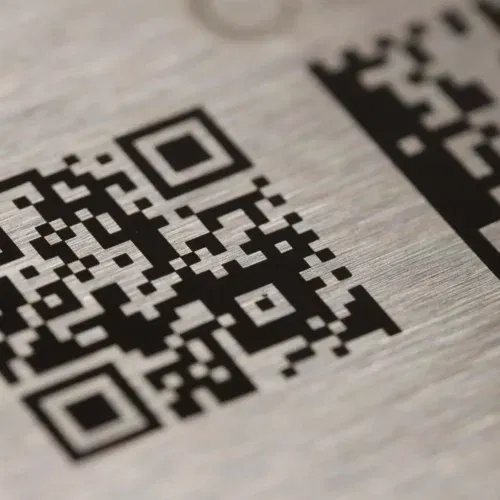 UV Micro-Etch
Thin Foil Etching
Burr-free micro-marking on ultra-thin stainless steel foils, titanium implants, and gold connector pads without thermal bleed.
Contact Us Clean Surface
Layer Removal
Selective laser ablation of surface coatings, paints, and anodized layers on curved housings with sub-micron edge crispness.
Contact UsSend your part samples directly to our UK application laboratory for a comprehensive report including microscopic inspection and surface roughness testing.
Contact UsAs global supply chains transition toward smart manufacturing and dynamic batching, procurement requirements for 3D UV laser marking systems have evolved beyond standalone desktop tools. Discover key technological shifts shaping corporate investments through 2030.
Contact UsIntegration of coaxial 3D stereoscopic vision sensors and LiDAR displacement meters that dynamically reconstruct part topography prior to firing, adjusting z-focus automatically without step files.
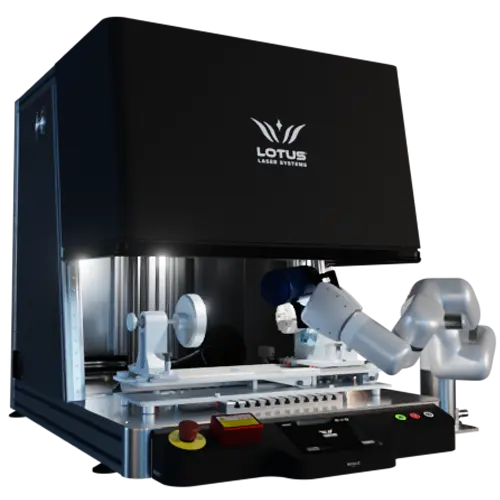
Interfacing 3D UV laser markers with collaborative robots (COBOTs) for unattended, continuous loading of complex non-planar components, reducing operator reliance and cycle times.
Mandatory implementation of ISO 15415 / ISO 29158 compliant DataMatrix codes on medical tools and pharmaceutical glass containers driven by EU MDR and US FDA regulations.
Modern DPSS 355nm UV sources achieve higher electrical-to-optical conversion ratios, lowering power usage by up to 40% compared to legacy lamp-pumped UV systems.
Transition from nanosecond UV pulse widths to picosecond and femtosecond regimes, virtually eliminating thermal diffusion and enabling sub-micron semiconductor wafer scribing.
Closed-loop inline optical spectrometers that scan mark contrast during the firing process, flagging defective surface chemistries instantly to enterprise MES platforms.
As a family-owned British laser manufacturer, Lotus Laser Systems (Laserite Ltd.) builds high-reliability 3D UV laser marking machines under rigorous quality control standards.
Our dedicated optical applications laboratory in Basildon, Essex has tested thousands of materials, ensuring backed application validation prior to capital equipment procurement.
Designed, assembled, and optical path-aligned in the UK using military-spec aluminum structural frameworks and premium optical components built for 15+ year operational lifespans.
We believe advanced focus control should not be an expensive optional add-on. Lotus Meta-C UV systems integrate 3-axis dynamic galvo focus as standard factory equipment.
Manufactured under ISO 9001 accredited quality management system and compliant with strict CE laser safety standards including dual-channel safety interlocks.
National Cyber Security Centre (NCSC) accredited. Secure firmware, encrypted machine communications, and data protection standard across all automation modules.
Operating across 46 countries with authorized factory-trained technical support engineers and stocked regional optical spare part inventories.
See how manufacturing companies resolved micro-fracturing, thermal damage, and focal depth limitations by upgrading to Lotus dynamic UV systems.
After 15 years evaluating CO2 and fiber lasers that caused glass micro-cracking, Arton adopted Lotus UV systems to etch complex curved glass without thermal stress.
Leveraging Lotus 3D dynamic focus technology to streamline production of high-end corporate awards, technical parts, and curved consumer items.

Eliminated manual rotary fixtures for multi-tiered metal and plastic components, improving batch marking throughput by 320% using Meta 3D focus control.
Comprehensive technical answers compiled by Lotus optical application specialists for global engineering, procurement, and QA leads.
Unlike 2D laser markers that rely on a static focal plane and F-theta lens—limiting depth of focus to a narrow tolerance window (typically ±0.5mm)—a 3D UV laser marking machine incorporates a dynamic dynamic expander lens controlled by a linear optic actuator prior to the X-Y scanning galvos. By dynamically shifting the focus position along the optical Z-axis in real-time correlation with galvo position, the laser beam maintains a consistent spot size (down to 15 µm) across inclined planes, stepped surfaces, cylinders, and complex 3D meshes without mechanical table movement.
Ultraviolet light at 355nm operates primarily via photolytic reaction (cold processing). The high photon energy of UV light (3.49 eV) directly breaks chemical bonds within organic polymer molecules rather than relying on thermal ablation (heat). This prevents charring, foaming, micro-cracking, or thermal stress in heat-sensitive substrates like HDPE, PEEK, silicone, and thin borosilicate glass, maintaining material structural integrity and strict ISO 10993 medical biocompatibility.
Industrial-grade DPSS 355nm UV lasers utilize Third Harmonic Generation (THG) crystals to convert 1064nm infrared light to 355nm UV light. Premium UV sources, such as those integrated into Lotus Meta-C systems, feature automated crystal shifting optics and sealed optical cavities, yielding operational lifespans between 20,000 and 30,000 hours under standard industrial operating environments before crystal refurbishment or diode replacement is required.
While 3D UV lasers can mark metals with ultra-fine, zero-damage black anneal or micro-etched contrast, they are optimized for delicate surface modification rather than heavy material removal. For deep metal engraving, a MOPA Fiber laser operating at 1064nm wavelength is far more efficient due to higher pulse energy absorption profiles in metals. UV lasers excel where zero thermal footprint, smooth tactile surface finish, or micro-scale resolution is mandated.
Because THG frequency-tripling optics are highly sensitive to thermal fluctuations, industrial 3D UV laser machines with output powers of 3W, 5W, 10W, or higher require precision closed-loop water chillers capable of maintaining temperature stability within ±0.1°C. Consistent thermal regulation preserves beam quality (M² < 1.2), pulse-to-pulse stability, and optical alignment during continuous, multi-shift production cycles.
Modern 3D UV laser control software, such as Lotus Meta-3D, directly imports standard 3D CAD vectors and surface formats including STL, STEP, IGES, and DXF. The software automatically maps 2D vector graphic layers onto the 3D target surface mesh, calculating the Z-axis focus offset matrix instantly without manual code writing.
Industrial 3D UV lasers emit Class 4 ultraviolet radiation internally. Complete turnkey systems must be enclosed within Class 1 laser safety housings incorporating CE compliance, certified optical safety windows (OD6+ at 355nm), dual-channel interlocks compliant with ISO 13849-1, and integrated ISO 9001 quality management manufacturing validation.
Validate your material processing parameters with Lotus Laser Systems. Our UK laser physics laboratory will analyze your 3D CAD step files, mark sample parts, and provide a comprehensive microscopic test report.
Speak directly with an application engineer today to select the optimal 3W, 5W, or 10W 3D UV laser setup for your line.
Phone: +44 1268 567540 · Email: [email protected]