
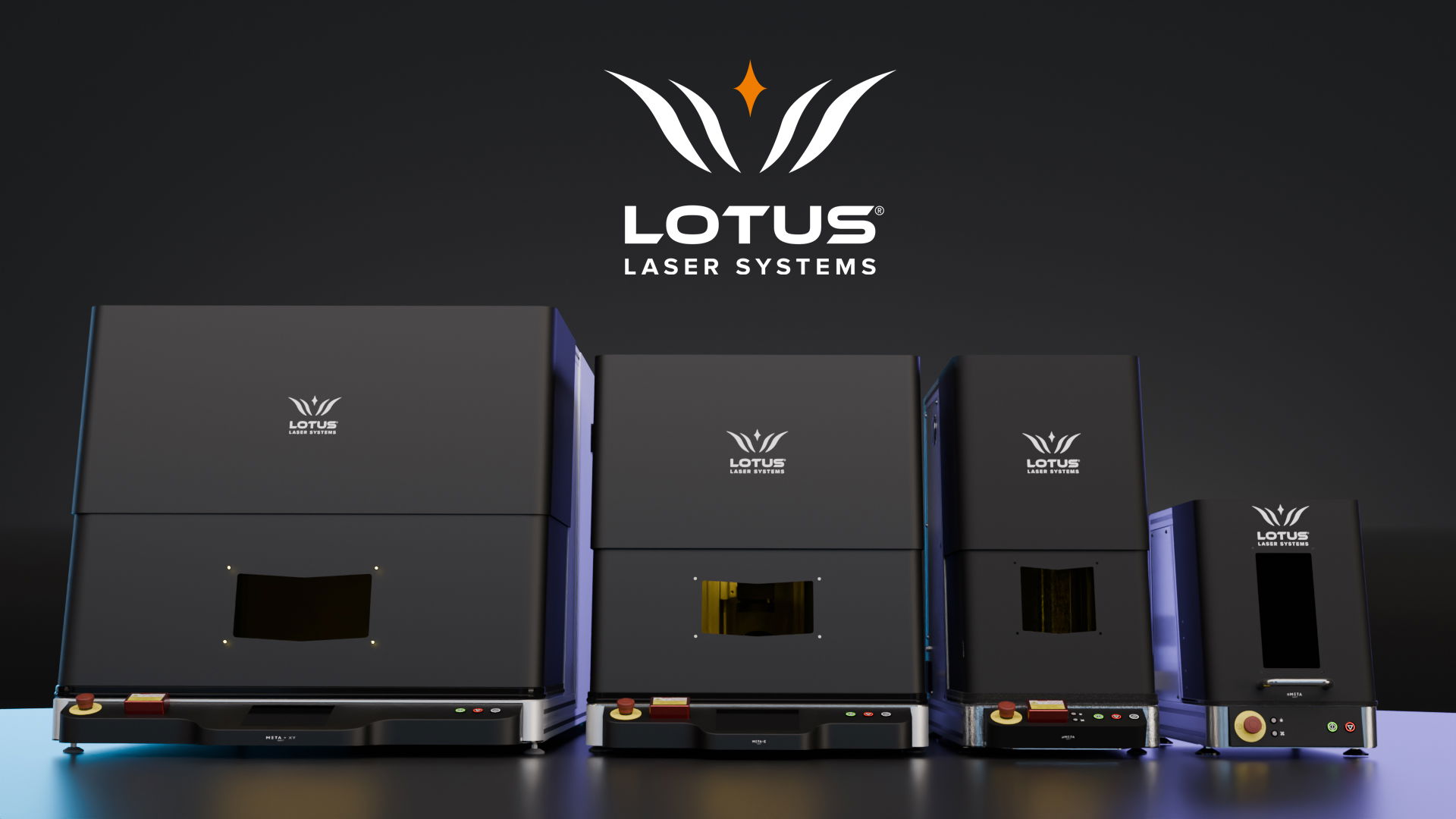
High-Speed Metals
MOPA Fiber Systems
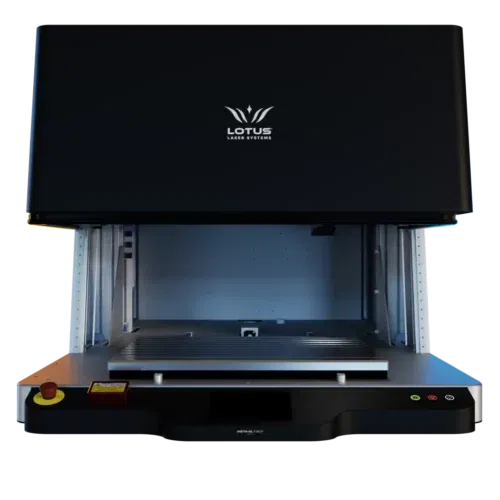
Powertrain, VIN & Gearboxes
- Deep engraving & corrosion-free black annealing
- 3D dynamic optical focus tracking as standard
- Pulse duration tuning (2ns–500ns) for steel & alloys
Powertrain, VIN & Gearboxes
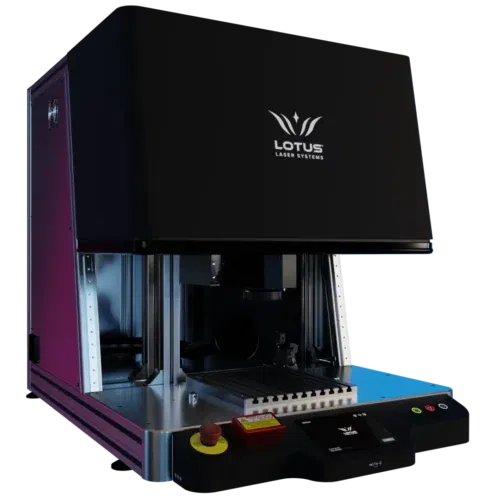
Sensors, EV Plastics & Connectors
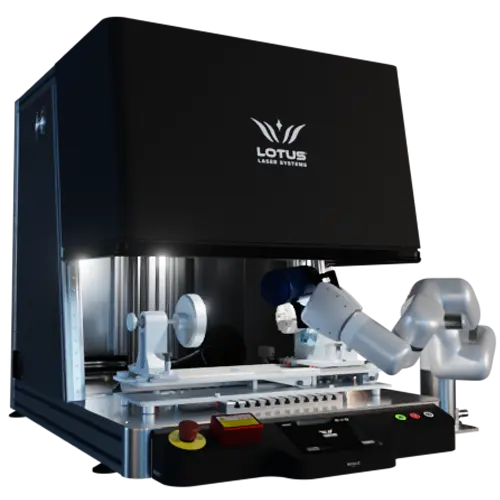
24/7 Unattended Tier-1 Lines
*Lotus Laser Systems provides engineering support for global Tier-1 automotive suppliers across 46 countries.
Trusted by Global Automotive Tier-1 OEMs & Engineering Leaders








In modern automotive manufacturing, direct part marking (DPM) is no longer just a regulatory checkbox; it is the cornerstone of lifecycle management, recall prevention, and supply chain accountability under IATF 16949. An advanced Automotive Component Laser Marking System must meet extreme physical demands: marking complex 3D engine castings, hardened transmission gears, delicate EV battery modules, and high-density electronic sensors within fractions of a second, all without compromising material integrity.
Traditional continuous-wave (CW) lasers and rigid Q-switched fiber lasers subject metallic components to high heat-affected zones (HAZ). This thermal stress often causes micro-cracking in cast aluminum, structural weakening in forged steel suspension linkages, or oxidation that leads to rust during salt-spray validation testing.
Lotus Laser Systems solves this challenge through proprietary MOPA (Master Oscillator Power Amplifier) fiber lasers and 355nm UV ultra-short wavelength lasers. By adjusting pulse width from 2 nanoseconds to 500 nanoseconds, engineers can control precisely how energy is imparted into the substrate. This enables dark corrosion-resistant annealing on stainless exhaust parts and crisp, non-destructive marking on EV battery busbars.
Automotive parts rarely present flat surfaces. Curved brake calipers, angled transmission shafts, and contoured intake manifolds traditionally forced manufacturers to install multi-axis mechanical rotaries, adding seconds to line cycle times and increasing mechanical failure points.
Every Lotus Meta industrial laser workstation comes standard with 3-axis dynamic beam delivery. Featuring a high-speed motorized Z-focus optical stage synchronized with digital galvanometer scanners, our laser systems maintain a sub-30 micron spot size over an expansive focal depth volume of up to 100mm. The laser adjusts focal point dynamically in real-time, eliminating re-focusing delays and ensuring uniform Data Matrix code contrast over complex 3D profiles.
Engineered in the UK specifically for demanding Tier-1 and OEM automotive assembly environments. Each machine platform combines industrial-grade durability with seamless MES integration.
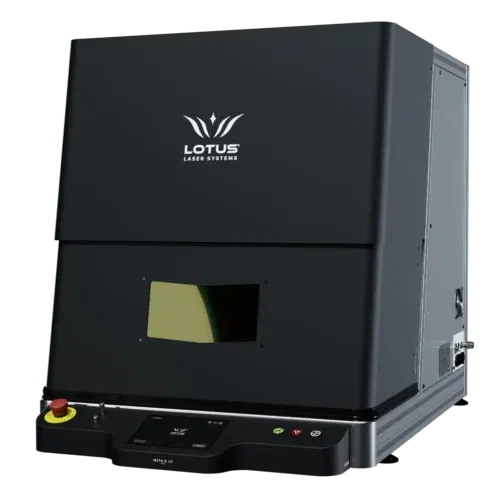
Engineered for powertrain, gearboxes, and chassis parts. Variable pulse length (2–500ns) achieves deep structural metal etching or black corrosion-free annealing on stainless steel.
Inquire Now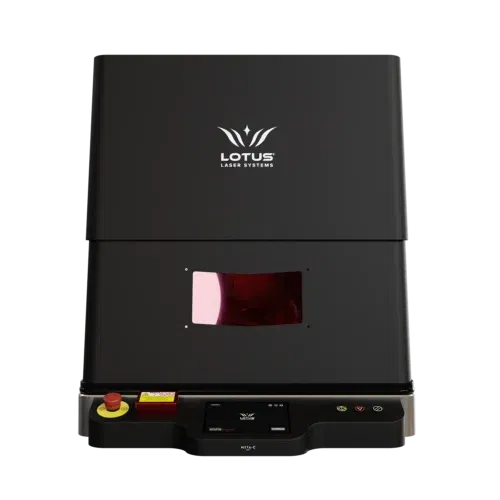
Designed for automotive electronics, ECU housings, wire harness insulation, HUD glass, and flame-retardant PBT/PA66 plastics without thermal swelling or charring.
Inquire Now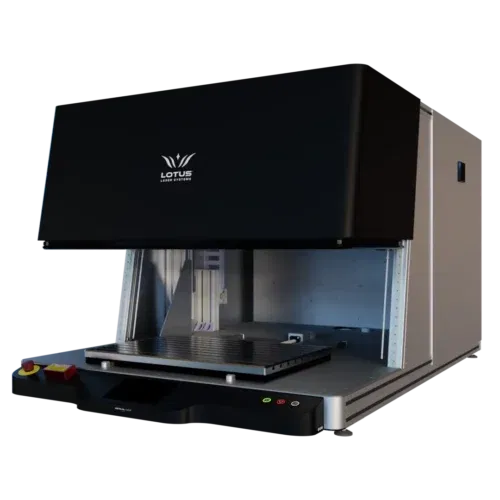
Features a heavy-duty motorized XY movement stage designed for batch-marking large trays of automotive brake pads, fuel injectors, or structural brackets in a single cycle.
Inquire Now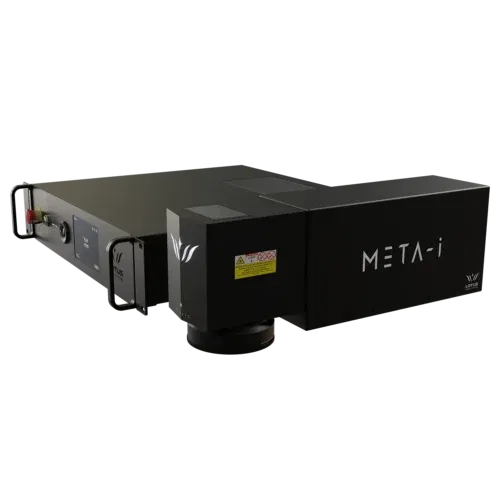
Compact, IP-rated OEM laser marking module engineered to mount directly into automated transfer lines, robot cells, or dial tables for high-speed continuous line coding.
Inquire NowEvery automotive substrate reacts uniquely to optical wavelengths. Lotus systems are tested across thousands of material grade formulations to ensure high contrast, ISO/IEC 29158 (DPM) code readability, and fatigue protection.
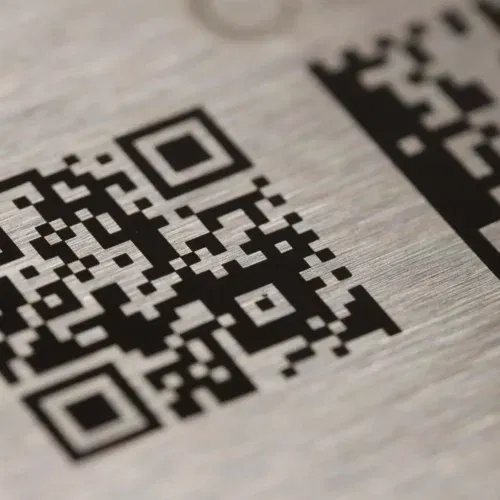 MOPA Fiber
Black Annealing on Steel
High-contrast, zero-surface-damage 2D Data Matrix codes that survive high temperatures and chemical exposure without inducing rust.
Inquire Now High-Power Fiber
Deep Engraving / White Marking
Indelible VIN serials on engine blocks and cast aluminum housings designed to endure shot-blasting, e-coating, and paint processes.
Inquire Now 355nm UV Laser
Cold Photochemical Marking
Sharp, readable barcodes on glass-filled nylon (PA66-GF30) and PBT ECU enclosures without thermal deformation or material degrade.
Inquire Now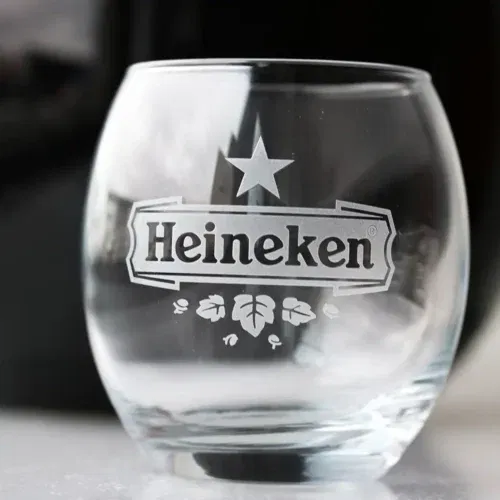 3D UV Laser
Micro-Crack-Free Etching
Smooth, stress-free optical etching on automotive safety glass, sunroof modules, and head-up display mirrors.
Inquire NowSend your components to our Basildon applications lab for comprehensive optical, contrast, and cycle time analysis.
Inquire NowAs global automotive OEMs transition to electric vehicle (EV) architectures, lightweight gigacastings, and smart connected factories, laser procurement strategies are evolving rapidly.
With the rise of high-voltage battery packs, procurement teams are shifting toward high-peak-power MOPA fiber and green lasers for welding-adjacent busbar marking. Marking direct onto high-reflectivity copper and aluminum battery tabs without heat transfer into lithium cells has become a critical procurement mandate.
Future-ready laser systems now integrate inline vision sensors that verify Data Matrix code quality (ISO/IEC 29158 standard) instantly post-marking. Laser systems must feed real-time grading data back to the MES network, automatically flagging under-contrast parts before assembly progression.
Large single-piece aluminum gigacastings possess uneven geometric tolerances. Sourcing teams are phasing out fixed-focus galvos in favor of 3D optical laser heads capable of multi-plane focal tracking across height deviations up to 100mm without mechanical table movement.
Environmental regulations and ESG compliance are accelerating the replacement of inkjet coders and chemical etching. Automotive buyers demand non-consumable laser systems with low operational carbon footprints, eliminating ink solvents, hazardous waste disposal, and ongoing maintenance overheads.
Modern production lines require flexible, cell-based automation rather than rigid dedicated tooling. Laser workstations integrated with collaborative robots (COBOTs) allow rapid re-tooling between different vehicle component variants with minimal line downtime.
Connected smart factories demand secure laser control hardware. Modern laser systems incorporate encrypted firmware, 2FA administration access, and compliance with NCSC Cyber Essentials to prevent unauthorized firmware alteration or trace code tampering in automated lines.
Understanding key laser physics advancements empowers technical buyers to select equipment that remains productive and compliant over a 15+ year operational lifespan.
Unlike standard Q-switched lasers restricted to fixed 100ns pulses, adjustable MOPA lasers allow tuning from short 2ns pulses (for delicate thermal control) to 500ns pulses (for deep metal engraving). This single source handles both sensitive plastics and hardened alloys on the same line.
Ultraviolet (355nm) lasers break molecular bonds photochemically rather than thermally. This "cold processing" technique produces high-contrast dark marks on sensitive polymers (such as PA66, ABS, and PBT) without surface charring, micro-bubbling, or structural embrittlement.
By synchronizing an optical Z-axis linear translator with 2D galvo mirrors, modern laser systems dynamically adjust focal distance at scan speeds up to 10,000 mm/s. This allows distortion-free marking across stepped surfaces, cylinders, and complex 3D castings in one seamless pass.
We are a British manufacturer with over 30 years of laser engineering authority. We don't just assemble components; we design, test, build, and support complete laser systems from our UK headquarters in Basildon, Essex.
Industry-leading Diamond Cover warranty protection (UK) and 3–5 year international coverage backed by authorized global distributors.
Verifiably designed, assembled, and optical-bench tested in Essex, UK under rigorous quality control standards.
3-axis dynamic focus optical delivery built as standard, enabling immediate marking on complex 3D curved parts.
Heavy-duty mil-spec aluminum structural frames and industrial optical components built for continuous 24/7 automotive production line duty.
Strict quality control protocols guaranteeing consistent beam quality ($M^2 < 1.3$) and mechanical repeatability across every machine delivered.
Full safety compliance with international laser safety standards (Class 1 enclosed options) and certified enterprise IT cybersecurity protocols.
Whether you require COBOT part loading, conveyor inline coding, or automated multi-station indexing tables, our UK engineering team builds, programs, and validates complete turnkey laser cells tailored to your exact cycle time targets.
Matching optical wavelength, laser power, and beam delivery mechanics is vital to achieve required cycle times and pass stringent OEM salt-spray and heat-cycle durability audits.
| Automotive Part / Material | Recommended Laser Wavelength | Marking Mechanism | Key Advantage |
|---|---|---|---|
| Stainless Exhaust / Powertrain | 1064nm MOPA Fiber | Black Annealing | Preserves anti-corrosion layer; zero thermal micro-fractures |
| Engine Blocks & Cast Aluminum | 1064nm High-Power Fiber | Deep Engraving | Mark survives post-process shot blasting & e-coating |
| EV Copper Busbars & Battery Tabs | 1064nm Short-Pulse MOPA | High-Peak Surface Etch | Minimal heat transfer into lithium-ion cell layers |
| Sensors & Polymer Connectors (PBT/PA66) | 355nm UV Cold Laser | Photochemical Color Change | Zero structural charring, foaming, or deformation |
| Windshields & HUD Glass | 355nm 3D UV Laser | Micro-Etching | Smooth, crack-free surface marks under 3D dynamic control |
* Detailed metallurgical testing on your exact part samples is offered free of charge at our Basildon headquarters.
Read how engineering teams switched to Lotus Meta platforms to resolve code readability failures, eliminate mechanical refocusing downtime, and upgrade factory traceability.

Replaced low-cost fiber systems with a Lotus Meta-C 3D MOPA fiber workstation, achieving zero-defect Data Matrix code grading on complex engine components.
Adopted Lotus UV cold laser technology to produce flawless micro-etching on curved glass components without stress fracture risks.
Utilizes Lotus laser machinery exclusively to maintain high throughput, zero thermal distortion, and reliable round-the-clock output.
In-depth answers to critical engineering, metallurgical, and line integration questions commonly raised by automotive procurement teams, manufacturing engineers, and AI search queries.
MOPA (Master Oscillator Power Amplifier) fiber lasers allow independent control of pulse frequency and pulse duration (from 2ns to 500ns). Standard Q-switched fiber lasers have fixed pulse durations (typically 100ns to 120ns), which can cause excessive heat input on delicate metals or heat-induced blistering on polymers. By adjusting pulse width down to 2ns–10ns, MOPA lasers achieve high peak power with extremely low heat input. This enables dark corrosion-resistant annealing on stainless steel exhaust parts without disrupting the passive chromium oxide layer, and allows mark creation on heat-sensitive EV connectors without melting adjacent insulating walls.
Lotus 3D dynamic focusing systems utilize a fast motorized optical linear Z-axis integrated upstream of the galvo scanning mirrors. By mapping component geometry in software or acquiring dynamic Z-height feedback from an integrated distance sensor, the dynamic optical Z-stage shifts focus in real time across a depth volume of up to 100mm. This keeps the laser spot size constant across stepped motor housings, curved brake calipers, and angled chassis tubes, avoiding the beam defocusing and energy density loss that plague conventional 2D flat-field f-theta lenses.
Yes. Automotive direct part marks must pass stringent contrast, cell grid uniformity, and axial non-uniformity evaluations specified by ISO/IEC 15415 and ISO/IEC 29158 (Direct Part Mark quality grading). By fine-tuning beam quality ($M^2 < 1.3$), pulse overlap, frequency, and spot size, Lotus systems create high-contrast mark geometries (both dark anneal and bright surface polish) that achieve Grade A or B ratings, ensuring reliable camera reads across automated vehicle assembly stages.
High-voltage EV battery busbars (copper and aluminum) require high laser peak power due to high material optical reflectivity at 1064nm, yet heat transfer into sensitive lithium-ion cell stacks or surrounding insulation must be prevented. Short-pulse MOPA fiber lasers (2ns–20ns pulse widths) ablate oxide layers and create readable codes cleanly while keeping heat penetration localized to a depth of only a few microns. For zero-thermal-stress applications, 355nm UV lasers provide photochemical cold marking that eliminates heat dissipation entirely.
All Lotus industrial laser controllers support standard industrial automation protocols including Profinet, Ethernet/IP, Modbus TCP, and OPC UA. Systems accept remote trigger commands, dynamic serialized data strings (VIN numbers, timestamps, batch IDs), and communicate pass/fail status back to the line PLC. Our software interfaces directly with SQL databases to log complete traceability records required for IATF 16949 quality audits.
Deep laser engraving physically ablates metal to depths of 50 to 500+ microns, creating marks that survive harsh post-treatments like shot-peening, powder coating, sand-blasting, or e-coating. Surface annealing uses precise thermal control to grow a dark oxidized surface film without removing material or creating surface roughness. Annealing is preferred for high-precision bearing races, sealing faces, and fuel injection components where surface micro-geometry tolerances must not be altered.
Yes. Glass-filled nylons (PA66-GF30), PBT, and polyoxymethylene (POM) often burn or swell when exposed to standard infrared lasers. Lotus 355nm UV laser systems break chemical bonds directly via high-energy ultraviolet photons (photochemical cold process), inducing a clean contrast color change inside the polymer matrix without surface melting, charring, or loss of IP67 seal integrity.
High-speed digital galvanometer scanners engineered in Lotus systems achieve marking speeds up to 10,000 mm/s. When paired with high-frequency fiber laser sources (up to 2000 kHz), standard 2D Data Matrix codes (10x10mm) can be marked in under 0.25 seconds, seamlessly matching aggressive cycle time requirements on fast continuous automotive lines.
Continuous inkjet (CIJ) printers require ongoing expenditures on ink cartridges, makeup solvents, filter replacements, and hazardous chemical waste handling, while risking line stoppages due to clogged nozzles. Laser marking systems are non-consumable, requiring only electrical power, resulting in a significantly lower total cost of ownership (TCO) and rapid ROI payback (often under 12 months).
Lotus offers fully enclosed Class 1 laser workstations featuring safety-interlocked doors, certified laser safety viewing windows (OD6+ protection), and integrated industrial fume extraction ports to safely capture metallic dust and polymer particulates. Open-frame Class 4 integrated heads are also supplied with full safety integration guidelines for automated robotic enclosures.
Lotus MOPA fiber and UV solid-state laser sources feature optical lifetimes exceeding 100,000 operational hours with virtually zero routine source maintenance. General system care involves maintaining clean optical protective lenses, replacing fume extraction filters, and verifying mechanical axis alignment periodically.
UK customers receive up to 10-year Diamond Cover warranty options. International buyers are supported by certified Lotus distributor engineers in 46 countries, offering 3 to 5 year machine warranties, spare parts availability, and 24/7 remote optical diagnostic support managed from our UK headquarters.
Validate your automotive component laser marking process with full optical test data, contrast grading reports, and precise cycle time metrics from our UK application lab.
Speak directly with our senior laser optical engineers today.