
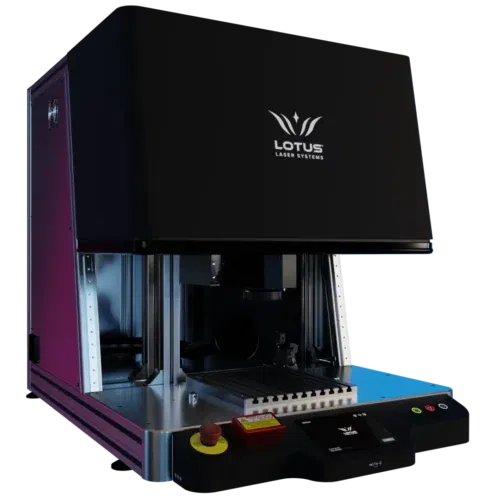
Standard Enclosure
Meta-C 3D UV Workstation
Class 2 closed workstation with 3D dynamic focus control as standard. Ideal for laboratory glass, medical vials, and premium spirits bottles.
High-precision 355nm UV laser systems for non-thermal etching on glass, crystal, and labware with zero microcracking.
Engineered to replace destructive CO2 thermal shattering and mess-prone sandblasting, Lotus UV laser markers break molecular bonds directly using 355nm short-wavelength laser light for crack-free, indelible results.
Class 2 closed workstation with 3D dynamic focus control as standard. Ideal for laboratory glass, medical vials, and premium spirits bottles.
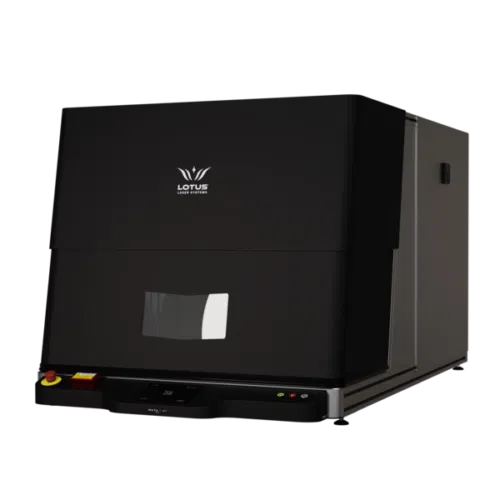
Featuring a 700mm x 500mm processing area for batch etching hundreds of glassware parts per cycle with automated multi-position positioning.
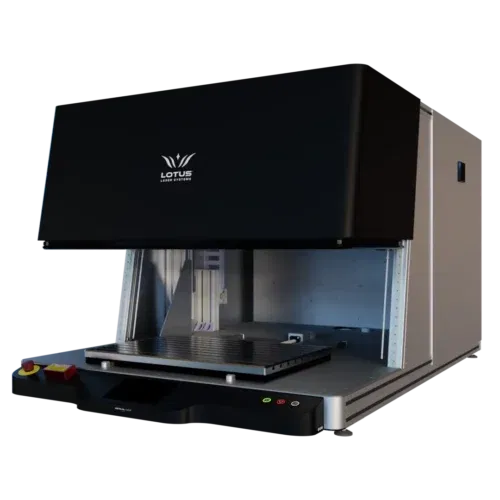
Expansive 1000mm x 600mm worktable designed for large architectural glass panels, automotive windscreens, and high-volume industrial production.
Comparing material stress, edge precision, and long-term operating costs across glass processing methods.
| Performance Factor | Lotus 355nm UV Laser | Traditional CO2 Laser | CNC Sandblasting |
|---|---|---|---|
| Processing Mechanism | Photolytic (Cold Photochemistry) | Photothermal (Thermal Melting) | Abrasive Kinetic Impact |
| Microcracking & Chipping | Zero Stress / None | High Risk of Micro-fractures | Surface Edge Roughness |
| Spot Size & Resolution | Ultra-Fine (~15-25μm) | Coarse (~100-300μm) | Limited by Stencil Thickness |
| Curved Surface Etching | 3D Dynamic Focus Standard | Requires Rotary Indexer | Requires Manual Masking |
| Consumables & Tooling | Zero Consumables | Zero Consumables | Abrasive Media & Stencils |
| Automated Inline Coding | Ready (GS1 / UDI Barcodes) | Unstable Micro-barcodes | Not Feasible Inline |
Delivering compliant, permanent markings for medical, automotive, aerospace, and commercial glass packaging sectors worldwide.
High-contrast DataMatrix barcode etching on borosilicate vials, test tubes, and syringes without leaching or structural weakness.
Indelible VIN, safety certification marks, and serial numbers etched onto laminated windscreens, side glass, and mirrors.
High-definition anti-counterfeiting codes and elegant branding on perfume flacons, crystal decanters, and spirits bottles.
Sub-surface micro-marking on touchscreens, OLED glass substrates, and precision optical lenses.
Detailed technical specifications and integration guidelines for international equipment buyers and manufacturing facility managers.
CO2 lasers mark glass via photothermal excitation, which shatters micro-grains of glass to create a rough frosted look. This introduces microcracks and internal stress. Lotus 355nm UV lasers utilize photolytic cold processing, breaking molecular bonds directly with high-energy UV photons. The result is a smooth, high-contrast, crack-free frost effect with no loss of structural integrity.
Yes. All Lotus Meta UV laser systems incorporate 3-axis dynamic beam focus control as standard. The system dynamically modulates the focal plane across 3D surfaces, allowing complex curved, sloped, or stepped glassware to be etched in a single automated cycle without manual refocusing or mechanical rotary indexing.
Lotus UV systems process soda-lime glass, borosilicate (Pyrex) labware, quartz glass, tempered safety glass, optical lenses, lead crystal, fused silica, and mirror coatings with consistent sub-micron precision.
Systems supplied to international buyers feature comprehensive 3 to 5 year warranties supported through our factory-trained authorized distributor network across 46 countries, backed directly by application specialists from our UK headquarters in Basildon, Essex.
Send your glass substrate samples to our UK applications laboratory for complimentary laser etching feasibility reports, micro-inspection, and optical cycle time analysis.
Consult directly with our industrial laser engineers for custom B2B proposals.
Direct Line: +44 1268 567540 · Email: [email protected]