0%

Inline Industrial Laser Coding Machine technology is becoming a practical choice for high-speed, traceable production lines in 2026. It marks dates, batch numbers, barcodes, and QR codes directly onto bottles, cartons, films, caps, and metal components. No ink cartridge is required. That matters in dusty factories, chilled rooms, and fast-moving packaging halls.

Industry research supports this shift. MarketsandMarkets estimates the global laser marking market will grow from about USD 3.0 billion in 2023 to USD 4.5 billion by 2028, representing an annual growth rate above 8%. Grand View Research also identifies automation, product traceability, and permanent marking as major market drivers. Packaging and manufacturing reports from PMMI repeatedly highlight the value of integrated coding, inspection, and data management. These findings are useful, but market forecasts vary by research method and product definition.

Real production experience adds another layer. A laser can produce crisp codes at conveyor speeds where traditional contact methods may struggle. However, “maintenance-free” is an imperfect description. Operators still need to manage lens cleanliness, extraction, software permissions, material compatibility, and safety interlocks. Small details matter. A dusty lens can turn a sharp QR code into a rejected carton.

This guide compares seven leading Inline Industrial Laser Coding Machine options for 2026. Each machine is considered through marking quality, line speed, integration, operating cost, service support, and safety design. The best choice is not always the most powerful model. It is the one that reliably fits the substrate, production rhythm, compliance needs, and long-term maintenance plan.
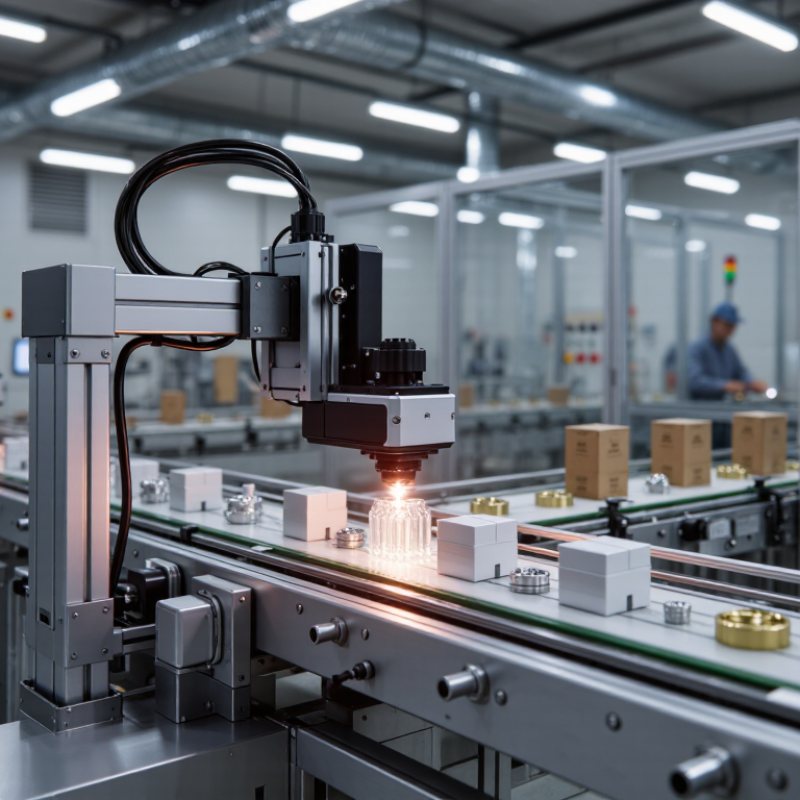
7 Best Inline Industrial Laser Coding Machines in 2026

Define Inline Laser Coding: 10.6 µm CO₂, 1.06 µm Fiber, and 355 nm UV

Inline laser coding places a laser head inside the production line, where products pass continuously beneath a scanner. The wavelength decides how the surface reacts. A 10.6 µm CO₂ laser suits paper, cardboard, glass, wood, and many films because these materials absorb infrared energy efficiently. A 1.06 µm fiber laser usually performs better on steel, aluminum, and engineered plastics. Its marks can remain readable after handling, abrasion, or moderate heat exposure.

Shorter wavelength matters. A 355 nm ultraviolet laser transfers energy through photochemical interaction, creating fine, low-thermal marks on sensitive plastics, coated films, and electronic components. Less heat can mean less melting, but not always. Settings still depend on pigment, line speed, focal position, and surface moisture. Experience matters here. The boundary is less neat than a chart suggests.

MarketsandMarkets estimated the global laser marking market at about USD 3.0 billion in 2023, with continued growth through 2028. Smithers’ packaging research also identifies traceability and variable data as expanding production requirements. These figures support inline adoption, but they do not select a wavelength for you. A practical trial should measure contrast, code quality, dust, rejected products, and maintenance time. That last metric is often overlooked. A technically perfect mark can still fail commercially when cleaning interrupts the line.

Rank the 7 Best Machines by 300–600 m/min Throughput and Uptime

At 300–600 m/min, inline laser coding depends on more than headline speed. This ranking weighs sustained throughput, uptime, print clarity, and recovery after faults. The ranking reflects practical production priorities, not laboratory performance.

1. Fiber laser systems rank first for high-speed coding on metal caps, cans, and coated surfaces. They often maintain stable output during long shifts. 2. CO2 laser systems follow closely for films, labels, cartons, and painted materials. Their wider marking areas suit fast conveyors. 3. UV laser systems rank third when heat-sensitive packaging needs sharp, low-impact marks. They cost more, but reduce substrate damage.

4. High-power CO2 units suit broad, continuous codes at 400–600 m/min. Cooling quality matters greatly. 5. Compact fiber units fit narrow lines and simpler date coding. Their smaller marking fields can limit dense messages. 6. Dual-head laser systems improve line coverage and reduce queueing on wide products. Alignment becomes a maintenance concern. 7. Hybrid laser platforms offer flexibility across materials, but their software and setup can slow changeovers.

Uptime depends on details operators notice daily. Look for automatic beam monitoring, sealed optics, encoder synchronization, and clear fault diagnostics. A machine that restarts in two minutes may outperform a faster unit requiring lengthy recalibration. Dusty cartons, vibration, and condensation can expose weak designs. Not every “600 m/min” claim survives real production. Test the exact substrate, code size, contrast, and conveyor spacing before purchase. Leave room for improvement.

Match Laser Types to Plastics, Metals, Glass, Cartons, and Flexible Films

7 Best Inline Industrial Laser Coding Machines in 2026

Material changes everything. Fiber lasers remain strong candidates for stainless steel, aluminum, and hard plastics because they deliver sharp, durable marks with limited consumables. CO2 lasers suit cartons, paper labels, glass, and many film surfaces. Their longer wavelength interacts efficiently with organic materials and coated packaging.

UV lasers deserve attention when heat-sensitive plastics or flexible films may deform. They create high-contrast marks with a smaller heat-affected zone, although their purchase and maintenance costs can be higher. Green lasers can improve contrast on selected glass and reflective substrates, but results depend heavily on coating, color, and line speed. According to MarketsandMarkets’ Laser Marking Market report, the sector is projected to grow from about USD 3.4 billion in 2024 to USD 5.0 billion by 2029. That growth reflects wider inline adoption, not a universal machine fit.

Smithers’ 2024 flexible-packaging outlook places global flexible packaging demand above USD 300 billion, increasing pressure for readable codes on thin films. In production trials, check contrast after abrasion, condensation, and heat exposure. Also test the full conveyor speed, not a slowed laboratory pass. A beautiful mark can still fail inspection.

Some recommendations may change.

Ink-free coding reduces fluid handling, but extraction, optics cleaning, and verification still require disciplined maintenance. Choose a machine by substrate behavior, required code life, and reject-control capability—not by laser power alone. Expect compromises.

7 Best Inline Industrial Laser Coding Machines in 2026 - Match Laser Types to Plastics, Metals, Glass, Cartons, and Flexible Films

Rank Inline Laser Coding Configuration Laser Type & Wavelength Best-Fit Materials Typical Marking Speed Typical Marking Field Recommended Code Types Inline Integration Key Advantages Important Selection Notes
1 High-Speed CO₂ Carton Coder Sealed CO₂ laser, 9.3 or 10.6 µm Paperboard, coated cartons, labels, treated glass, PET and PE films Up to approximately 10,000–30,000 mm/s, depending on code and substrate Typically 50 × 50 to 110 × 110 mm Batch numbers, expiry dates, barcodes, QR codes, logos and alphanumeric text Conveyor, carton former, case packer and high-speed packaging lines; photoelectric trigger and encoder support Fast non-contact coding; no ink, solvent or consumable cartridge; suitable for porous and coated packaging Confirm film additives, coating chemistry and required contrast. Excessive power can burn thin films or darken cartons.
2 Fiber Metal Part Marker Pulsed fiber laser, 1,064 nm Stainless steel, carbon steel, aluminum, brass, copper and nickel alloys Approximately 2,000–12,000 mm/s; deep engraving is slower Typically 70 × 70 to 200 × 200 mm Serial numbers, Data Matrix codes, logos, 2D traceability codes and shallow engraving Parts conveyors, rotary fixtures, indexing tables and robotic cells; encoder and PLC communication available High contrast on metals, long source life and strong resistance to abrasion, heat and chemicals For highly reflective copper or aluminum, verify power, pulse control, beam delivery and safety enclosure requirements.
3 MOPA Fiber Plastic-and-Metal Coder Adjustable-pulse fiber laser, 1,064 nm ABS, PA, PC, POM, PET, anodized aluminum and coated metals Approximately 2,000–10,000 mm/s Typically 70 × 70 to 160 × 160 mm High-resolution text, QR codes, Data Matrix codes, date codes and contrast marks Continuous conveyors and intermittent-motion lines with vision inspection and product tracking Pulse-width control helps reduce melting, foaming and excessive heat on engineered plastics Plastic response depends on pigment, filler, flame retardant and surface finish. Test production-grade samples.
4 UV Cold-Marking Coder Ultraviolet laser, 355 nm Sensitive plastics, medical polymers, films, painted surfaces, glass and electronic components Approximately 1,000–6,000 mm/s Typically 50 × 50 to 150 × 150 mm Fine text, microcodes, 2D codes, logos and high-density traceability information Cleanroom-compatible or enclosed conveyor systems; supports vision, encoder and PLC interfaces Low heat-affected zone and excellent detail on materials that may melt or discolor under infrared lasers Higher initial cost and stricter optical-safety controls are common. UV transmission and surface chemistry affect results.
5 Green Laser Reflective-Material Coder Green laser, 532 nm Copper, brass, gold-colored coatings, reflective films and selected transparent or colored plastics Approximately 500–5,000 mm/s Typically 50 × 50 to 120 × 120 mm Fine serial numbers, QR codes, Data Matrix codes, logos and surface color changes Indexing conveyors, wire-and-cable lines, electronics assembly and precision part handling Better coupling to some reflective metals than 1,064 nm systems; can provide controlled, low-damage marking Actual performance varies significantly with alloy, plating and surface roughness. Use a sample test before specifying speed.
6 Glass and Ceramic CO₂ Coder CO₂ laser, 10.6 µm Glass bottles, ceramic containers, glazed surfaces and selected coated glass Approximately 500–5,000 mm/s, depending on contrast method and container motion Typically 50 × 50 to 110 × 110 mm Lot codes, expiry dates, barcodes, QR codes, logos and decorative marks Bottle conveyors, rotary wheel systems and packaging lines with container detection and shaft encoding Permanent non-contact marking with no wet ink; suitable for many high-temperature and washdown applications Validate readability, surface stress and breakage risk. Curved containers may require rotary marking or dynamic focusing.
7 Flexible-Film CO₂ or UV Coding System CO₂, 9.3/10.6 µm, or UV, 355 nm, selected by film construction PE, PP, PET, BOPP, multilayer laminates, pouches and shrink films Approximately 1,000–15,000 mm/s, depending on film speed and code complexity Typically 50 × 50 to 110 × 110 mm Date codes, batch codes, barcodes, QR codes, logos and variable text Form-fill-seal, vertical bagger, horizontal flow-wrapper and film-converting lines; encoder synchronization recommended No contact with moving film and no ink migration; UV is useful when heat input must be minimized Choose the wavelength after checking film thickness, pigments, metallization, seal layers and required readability after packaging.
Data note: Speed and marking-field figures are typical engineering ranges for inline industrial systems, not guaranteed production rates. Actual throughput depends on code size, character height, line speed, material formulation, surface condition, focal distance, required contrast, scanner settings and verification requirements. Laser enclosures, interlocks, extraction and wavelength-specific safety controls should be specified according to the applicable local regulations.

Evaluate Code Quality with ISO/IEC 15415, IP65, and Traceability Standards

7 Best Inline Industrial Laser Coding Machines in 2026

Choosing an inline industrial laser coding machine requires more than checking speed and resolution. Code quality must be measured under ISO/IEC 15415, especially for Data Matrix symbols. A verifier should inspect contrast, cell damage, axial non-uniformity, and grading performance. Do not rely on camera images alone. They can look sharp while failing verification. In production trials, I would test codes on dark film, coated cartons, and curved containers. Print samples at the fastest planned line speed. Small changes in focus can affect the final grade.

IP65 protection also matters in dusty or washdown-prone areas. It indicates complete dust protection and resistance to water jets. It does not mean the coder can be submerged. Check the enclosure, cable glands, cooling system, and lens window. A clean lens often improves readability more than higher laser power. That detail is easy to miss.

Traceability should connect each code with a product, batch, timestamp, operator, and inspection result. Secure data storage and controlled access reduce unexplained gaps. The machine should also record rejected codes and communication failures. This is where many evaluations become overly optimistic. A promising test run is not a production guarantee. Verify performance after shift changes, material variation, and routine cleaning. Leave room for doubt. Reliable coding comes from repeatable evidence, not attractive samples.

7 Best Inline Industrial Laser Coding Machines in 2026

Standards-based screening index using ISO/IEC 15415 code-quality readiness, IP65 ingress protection, and traceability capability. ISO/IEC 15415 grades 2D symbols from 0 to 4, while IP65 indicates dust-tight protection and protection against water jets.

The index is calculated from three measurable criteria: ISO/IEC 15415 code-quality readiness at 40%, ingress protection at 30%, and traceability functions at 30%. Values are anonymous evaluation profiles rather than manufacturer claims.

Compare Total Cost of Ownership, Maintenance, and 20,000-Hour Laser Life

The seven strongest inline laser coding machines should be judged by total cost of ownership, not purchase price. A 20,000-hour laser life sounds impressive, but it depends on duty cycle, enclosure temperature, power quality, and cleaning discipline. In a two-shift plant, that equals roughly eight years before planned laser replacement. Actual life may be shorter.

Maintenance creates the hidden bill. Operators should compare lens cleaning intervals, filter costs, extraction requirements, calibration time, and spare-part availability. A five-minute cleaning routine can prevent blurred characters on dusty cartons. A failed extractor can stop an entire line. Downtime hurts twice. It loses production and consumes technician hours.

The International Federation of Robotics recorded 541,302 industrial robot installations in 2023, showing how quickly automated production is expanding. Deloitte’s 2023 Smart Manufacturing Survey found that 86% of manufacturing leaders expect smart operations to become a primary competitiveness factor. These figures support inline coding investment, but they do not prove every machine delivers value. A lower-energy unit may win when electricity and extraction run continuously. A more expensive system may still lose if service response is slow. I would score the seven options using five-year TCO, including energy, consumables, labor, downtime, and laser replacement. The spreadsheet can still lie. Test real cartons, line speeds, dust levels, and restart behavior before approval.

FAQS

Which laser type suits metal caps and cans at 300–600 m/min?

Fiber systems usually fit stainless steel, aluminum, and hard plastics. They can maintain sharp marks during long shifts. Check coating behavior, code contrast, and restart time. Maximum speed claims can disappoint.

When are CO2 systems a better choice?

CO2 systems suit cartons, paper labels, glass, painted surfaces, and many films. Their broad marking areas help on fast conveyors. They need suitable extraction and clean optics. Not every film responds equally.

Why choose a UV laser for heat-sensitive packaging?

UV systems create sharp, low-impact marks with a small heat-affected zone. They can reduce deformation on thin plastics and flexible films. Purchase and maintenance costs are often higher. The benefit needs testing.

Is 600 m/min realistic in daily production?

Sometimes, but not automatically. Test the exact material, code size, contrast, and conveyor spacing. Include dust, vibration, condensation, and full-shift operation. A slower machine may win if recovery takes two minutes.

What uptime features deserve attention?

Look for automatic beam monitoring, sealed optics, encoder synchronization, and clear fault diagnostics. These features support stable coding and faster recovery. Ask operators to inspect cleaning access. Small service delays accumulate.

Are compact fiber systems suitable for narrow production lines?

They can fit narrow lines and simple date codes. Their smaller marking fields may restrict dense messages. Confirm character height and spacing before purchase. Compact does not mean universally flexible.

What are the advantages and risks of dual-head systems?

Dual-head systems can cover wide products and reduce queueing. Alignment becomes a maintenance concern. Test synchronization after cleaning and vibration. More heads mean more coordination.

How should hybrid laser platforms be evaluated?

Hybrid platforms handle varied materials and may reduce equipment changes. Their software and setup can slow changeovers. Measure real changeover minutes, not brochure flexibility. Some flexibility is expensive.

How can operators confirm that marks remain readable?

Inspect contrast after abrasion, condensation, and heat exposure. Verify codes at full conveyor speed, not only during slower trials. Connect verification with reject control. Beautiful marks can still fail inspection.

Does ink-free coding remove maintenance concerns?

No. It reduces fluid handling, but optics cleaning, extraction, and verification remain necessary. Expect compromises. Review maintenance records before deciding. Some assumptions need rethinking.

Conclusion

An Inline Industrial Laser Coding Machine provides fast, permanent, and contact-free marking for modern production lines. This guide compares seven machine configurations designed for 300–600 m/min throughput, focusing on uptime, synchronization, code consistency, and practical integration with conveyors and inspection systems. It explains how 10.6 µm CO₂ lasers suit cartons, glass, and selected plastics, while 1.06 µm fiber lasers are effective for metals and durable industrial surfaces. For heat-sensitive plastics, films, and fine-detail applications, 355 nm UV lasers can deliver precise, low-thermal-impact marking.

The comparison also considers compatibility with flexible films, packaging materials, and coated substrates, along with enclosure protection such as IP65 for demanding factory environments. Code quality is evaluated through readability, contrast, ISO/IEC 15415 verification, and traceability requirements. Finally, the guide examines total cost of ownership, including installation, consumables, cleaning, servicing, energy use, downtime risk, and the potential value of laser sources rated for up to 20,000 hours.

Ethan Parker

Ethan Parker

Ethan Parker is a professional marketing specialist with a strong understanding of the company’s products, their practical applications, and the needs of the customers they serve. He works closely with internal teams to turn product knowledge into clear, useful information, helping readers make......