China has become a major manufacturing base for laser engraving equipment, but choosing the right In-Store Retail Laser Engraver requires more than comparing prices. Retail buyers must examine engraving speed, safety design, software stability, training, warranty support, and material compatibility. A machine may look impressive in a showroom and still disappoint during a busy personalization campaign.
Market evidence supports this opportunity. Grand View Research reports continued growth in the global laser technology market, driven by automation, customization, and manufacturing efficiency. Fortune Business Insights also identifies rising demand for laser engraving machines across commercial and industrial applications. Meanwhile, the National Retail Federation has highlighted personalization as an important part of modern customer experience. These reports do not guarantee every retail investment. They show the direction of the market.
Theodore Maiman, the laser inventor, famously said, “The laser is a solution looking for a problem.” Retailers should remember that warning. The best In-Store Retail Laser Engraver is not automatically the most powerful model. It is the model that fits a store’s queue length, product range, ventilation plan, operator skills, and service expectations. Picture a customer waiting beside a counter while a name is engraved on a wooden gift. Every second matters. Small details matter more.
China’s strongest suppliers can offer competitive engineering, flexible configurations, and export experience. Yet quality varies. Certifications, factory testing, sample verification, and after-sales response deserve careful review. This guide examines those practical differences for global buyers. Some recommendations may still need adjustment. Retail environments are rarely identical.
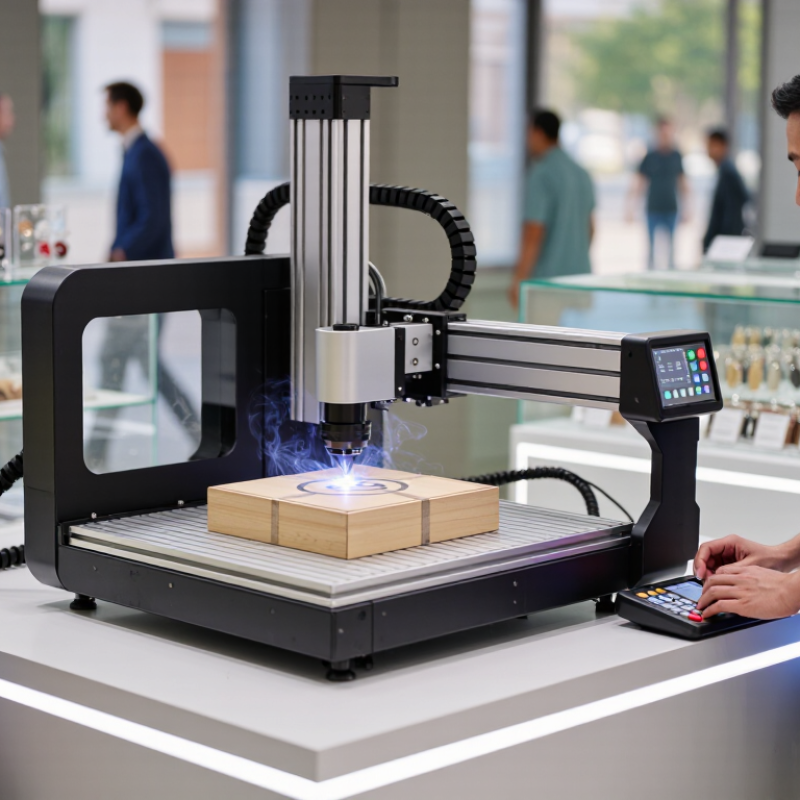
Laser Engraver Types: CO₂ 10.6 µm, Fiber 1.064 µm, and Diode 450 nm
For global retail buyers, wavelength determines what an in-store laser engraver can mark.
CO₂ lasers operate at 10.6 µm, making them effective on wood, acrylic, paper, leather, and coated glass. Their broad heat profile can leave softened edges on thin materials, so test pieces remain essential.
Fiber lasers use 1.064 µm infrared light. They are better suited to stainless steel, aluminum, brass, and other bare metals, producing crisp serial numbers or personalized text.
Diode lasers, commonly around 450 nm, offer lower entry costs and compact footprints. They can mark wood, dark plastics, painted surfaces, and some anodized metals, but results vary sharply with color and coating.
Market evidence supports continued demand for these systems. Grand View Research estimated the global laser marking machine market at approximately USD 3.0 billion in 2022, with projected growth through 2030. MarketsandMarkets also identifies electronics, packaging, and automotive production as major application sectors in its laser marking market analysis. Retail customization reflects the same trend, but usually at smaller scale. A counter-top machine must balance speed, ventilation, noise, and operator training.
Do not choose by wattage alone. Experienced buyers compare spot size, pulse control, working area, software support, and service availability. IEC 60825-1 requires laser safety classification, while enclosure design can reduce exposure risks. One practical mistake is assuming every dark surface absorbs 450 nm light equally. It does not. Material samples can disagree with catalog claims. That is inconvenient, but useful. A short trial on actual merchandise often reveals more than a polished specification sheet.
FAQS
Request the EU Declaration of Conformity, EMC reports, RoHS records, and IEC 60825-1 safety evidence. Check model numbers carefully. Small mismatches matter.
No. CE marking is a manufacturer declaration, not one government-issued certificate. Review supporting test records and the exact machine model.
Check the certificate scope, factory address, issuing body, and expiration date. ISO 9001 confirms quality management, not automatic product safety.
Request a live video showing the engraver, serial label, emergency stop, interlock, and laser classification label. Documents alone can look convincing.
It should prevent accessible laser radiation during normal operation. The door interlock must stop emission immediately. Safety checks still remain necessary.
Dust can weaken seals, while damaged viewing windows may create uncertainty. Inspect the enclosure regularly. Do not assume Class 1 lasts forever.
Engraving wood, plastics, and coated metals can release particles or vapors. Use suitable filters, an airflow indicator, and scheduled filter replacement.
No. Acceleration, artwork density, and material settings affect real output. Measure completed jobs per hour, not only the headline speed.
Request a sample engraving on your intended material. Compare its edges, detail, and rework needs. I might still miss something, so independent inspection helps.
Keep a simple log for interlock tests, filter changes, enclosure checks, and emergency procedures. Short records help reveal repeated problems.
Conclusion
Choosing an In-Store Retail Laser Engraver from China requires a clear understanding of technology, performance, compatibility, and safety. CO₂ lasers operating at 10.6 µm are well suited to wood, acrylic, glass, leather, and coated products, while fiber lasers at 1.064 µm are designed for precise metal marking. Diode lasers around 450 nm can provide a practical option for selected wood, leather, and coated materials. For retail environments, useful benchmarks include 20–60 W power, a 300×300 mm working bed, 0.01 mm accuracy, and speeds reaching up to 1,000 mm/s, depending on the material and task.
Before purchasing, global buyers should verify supplier documentation, including CE, FCC, RoHS, IEC 60825-1, and ISO 9001 credentials. In-store operation should prioritize Class 1 enclosed designs, effective fume extraction, clear user controls, and an efficient workflow. Evaluating sample results, maintenance support, training, warranty terms, and material testing can help retailers select a reliable, safe, and versatile engraving solution.