China’s Cobot Laser Automation System market is expanding across welding, cutting, marking, and precision handling. Factories now seek systems that combine collaborative robots, laser sources, vision cameras, and safety controls. The strongest suppliers are not always the largest robot manufacturers. Some specialize in laser welding cells, while others integrate complete production lines.
Esben Østergaard, co-founder of Universal Robots, once described collaborative robotics this way: “The whole idea with collaborative robots is to make automation accessible to everybody.” That principle remains useful when evaluating Chinese suppliers. A capable supplier should explain payload limits, laser power, positioning accuracy, cycle time, and operator protection clearly. Demonstrations should show real materials, not only polished showroom samples.
This guide examines leading China Cobot Laser Automation System suppliers through practical criteria. These include engineering experience, component quality, software usability, after-sales support, and documented safety procedures. Supplier transparency matters. A low purchase price may hide difficult programming, weak spare-parts support, or costly integration changes.
Some buyers may expect one supplier to excel in every category. That assumption needs reconsideration. A company may offer excellent laser welding but limited vision integration. Another may provide strong robotics support but depend on outside laser manufacturers. Actual performance can also vary between projects, even within the same factory.
The following overview therefore avoids treating rankings as permanent facts. It focuses on supplier capabilities, application fit, and evidence that buyers can verify. Test samples, factory visits, reference projects, and technical contracts remain essential before making a final decision.
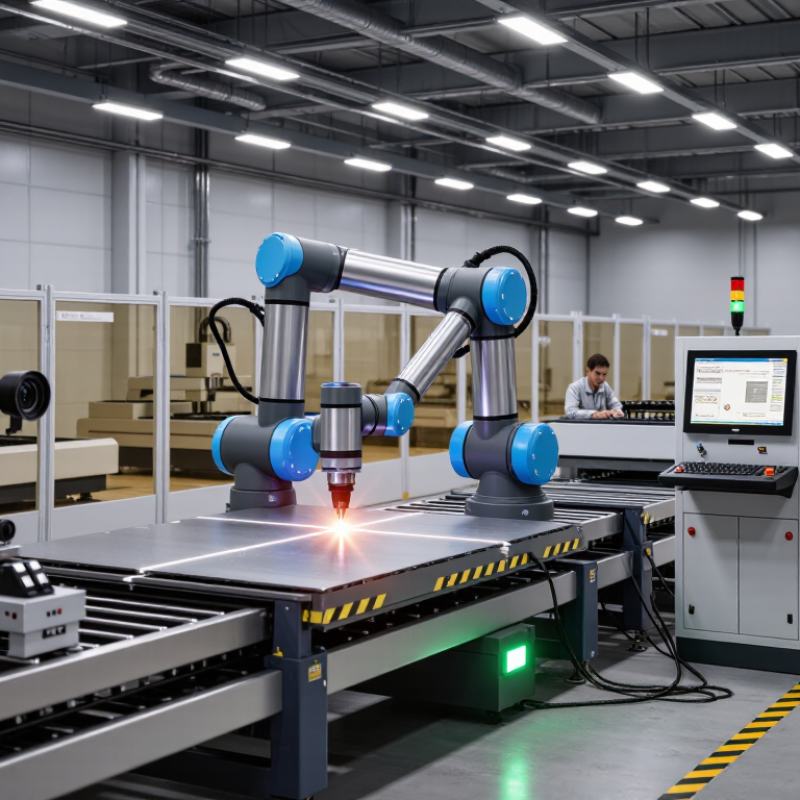
A cobot laser automation system combines a collaborative robot, laser source, motion controller, sensors, and protective equipment. The robot guides the laser head along a programmed path. It may weld, clean, mark, cut, or surface-treat selected materials. Unlike a traditional industrial cell, a cobot system is designed for closer human interaction. However, “collaborative” does not mean risk-free. Laser radiation, heat, fumes, and unexpected movement still require professional risk assessment.
In a typical workshop, an operator loads a metal part onto a fixture and selects a verified program. Vision sensors can check its position before processing begins. The controller then adjusts speed, power, and travel distance. A stable fixture matters greatly. Even a small shift can create uneven welds or incomplete cleaning. Practical commissioning should include calibration, sample testing, emergency stops, guarding, and operator training. These steps often take longer than expected.
Reliable suppliers should provide traceable specifications, documented safety tests, training, maintenance guidance, and responsive technical support. They should explain cycle time using real material thicknesses, not ideal demonstrations. Ask how the system handles reflective surfaces, dust, lens contamination, and calibration drift. Some systems appear simple during a showroom test. Production is less forgiving. A useful trial should measure bead consistency, surface quality, downtime, and operator workload across repeated runs. One weakness remains common: users may focus on robot speed while overlooking extraction, tooling, and process monitoring.
Cobot laser automation systems combine a collaborative robot, laser source, sensors, and control software. The robot moves the laser head along programmed paths. A vision camera can locate seams, holes, or irregular edges before processing begins. Force and distance sensors help maintain a stable working position.
The workflow usually starts with a CAD file or recorded teaching path. The controller converts that path into robot movements and laser parameters. During welding, cutting, or surface treatment, sensors monitor distance, speed, temperature, and beam alignment. A shielding gas system may protect the weld area. Fume extraction is also essential in enclosed production cells.
Safety remains central. Interlocked doors, area scanners, emergency stops, and controlled laser access reduce exposure risks. Collaborative movement does not make laser radiation harmless. That assumption fails. The International Federation of Robotics reported 541,302 industrial robot installations worldwide in 2023, showing strong demand for automated production. Its World Robotics 2024 report also recorded more than 4.2 million industrial robots operating globally. These figures do not measure laser cobots directly, but they indicate a mature automation environment.
In practice, suppliers should provide process trials, risk assessments, and sample-quality data. A reflective metal surface can confuse vision sensors. Heat distortion can also shift the programmed path. Human operators still inspect critical joints and adjust parameters. The system saves labor, but setup quality decides the result. Performance claims need independent testing, not attractive demonstrations.
Cobot laser systems combine a collaborative robot arm, a laser processing head, sensors, motion control, and safety interlocks. The representative power levels below reflect commonly specified industrial operating points: cleaning generally uses lower power, while cutting and cladding require higher power. Actual settings vary according to material, thickness, speed, beam size, and process requirements.
Reference values are representative engineering setpoints, not market-share data or supplier performance ratings.
China’s leading cobot laser automation suppliers are usually system builders, not robot manufacturers alone. They combine collaborative arms, fiber-laser sources, vision cameras, safety scanners, and welding software. This integration matters because a factory needs stable seams, controlled heat, and repeatable torch angles.
The International Federation of Robotics reported 276,288 industrial robot installations in China during 2023, representing more than half of global deployments. That scale supports a deep domestic supply chain. Meanwhile, industry analyses from Interact Analysis identify Asia-Pacific as the largest collaborative robot region, driven by flexible manufacturing and labor shortages. Chinese suppliers lead when they offer modular cells for sheet-metal welding, fixture loading, surface cleaning, and small-batch production.
Look for evidence, not slogans.
A credible supplier should provide measured cycle times, weld penetration records, laser power data, and acceptance-test procedures. Field experience also reveals practical details: a compact cell may fit beside a press brake, while automatic nozzle cleaning reduces downtime during long shifts. Suppliers with in-house software teams often adapt vision settings faster than equipment resellers. However, published market reports rarely separate cobot laser systems from broader robotic automation. Rankings can therefore appear more precise than they are. Buyers should verify installed projects, maintenance response, electrical compliance, and operator training before choosing a supplier.
| Anonymous Supplier Profile | Market Position | Primary Automation Strength | Typical Cobot Payload | Typical Laser Power Range | Supported Laser Processes | Vision and Sensing | Turnkey Integration | Main Application Areas | Service Coverage |
|---|---|---|---|---|---|---|---|---|---|
| Supplier Profile A | Leading Integrator | Standardized collaborative laser welding cells with automated fixtures and recipe management | 10–20 kg | 1–6 kW | Laser welding, seam tracking, position correction and weld inspection | 2D cameras, laser seam tracking and force-related collision monitoring | Yes | Automotive components, metal enclosures, machinery and stainless-steel fabrication | National project support with regional commissioning teams |
| Supplier Profile B | Leading Integrator | Flexible cobot laser cutting and welding systems for small- and medium-batch production | 10–20 kg | 1–4 kW | Laser cutting, welding, tack welding and automated part handling | 2D part recognition, camera-based alignment and height sensing | Yes | Sheet metal, kitchen equipment, electrical cabinets and customized fabrication | National coverage through direct and channel-based service |
| Supplier Profile C | Strong Competitor | Portable cobot laser welding equipment designed for rapid deployment and operator mobility | 5–15 kg | 1–3 kW | Laser welding, fillet welding, butt welding and repair welding | Basic camera alignment, weld-path teaching and optional seam tracking | Yes | General fabrication, furniture, doors, frames and repair operations | Strong regional coverage with distributor support |
| Supplier Profile D | Strong Competitor | High-throughput laser cleaning and surface-treatment cells using collaborative robots | 10–20 kg | 1–3 kW | Laser cleaning, paint removal, rust removal and surface preparation | Distance monitoring, scanning-path control and programmable motion profiles | Yes | Steel structures, molds, ship components, machinery and maintenance operations | Regional engineering support with remote commissioning options |
| Supplier Profile E | Application Specialist | Customized laser cladding and repair systems for high-value industrial parts | 10–20 kg | 2–6 kW | Laser cladding, additive repair, hardfacing and precision remanufacturing | 3D scanning, height measurement and closed-loop process monitoring | Yes | Mining equipment, energy components, molds, hydraulic parts and heavy machinery | Project-based support concentrated in industrial regions |
| Supplier Profile F | Application Specialist | Compact cobot laser marking and micro-processing systems for traceability applications | 3–10 kg | 20 W–500 W | Laser marking, engraving, coding and low-power surface treatment | Barcode recognition, camera inspection and automatic workpiece positioning | Available by project | Electronics, medical devices, hardware, packaging and consumer products | Broad distributor network with application-specific support |
| Supplier Profile G | Strong Competitor | Integrated laser welding lines combining cobots, rotary fixtures and automatic feeding | 15–25 kg | 2–6 kW | Continuous welding, circumferential welding, spot welding and automated loading | 2D/3D vision, seam tracking and fixture verification | Yes | Automotive parts, battery housings, pressure vessels and industrial assemblies | National coverage for larger factory projects |
| Supplier Profile H | Application Specialist | Entry-level cobot laser automation packages for small manufacturers and education-oriented users | 3–10 kg | 500 W–2 kW | Basic laser welding, marking, cleaning and manual-load automation | Manual teaching with optional camera-based positioning | Available by project | Job shops, vocational training, prototyping and low-volume production | Local and regional service coverage |
Comparing suppliers requires more than checking laser power or catalog prices. Examine the complete working cell, including the collaborative robot, laser source, positioner, enclosure, extraction, and control software. Ask for cutting or welding samples using your actual material, thickness, and joint design. A smooth demonstration may hide difficult setup work.
Check technical performance with measurable evidence. Review repeatability, positioning accuracy, cycle time, payload, and thermal stability. Request test reports and a recorded acceptance procedure. The supplier should explain how sensors detect part movement and how the system responds to an interrupted process. Clear answers matter. Vague promises create expensive delays.
Service capability deserves equal attention. Confirm installation support, operator training, spare-part availability, software updates, and remote diagnostics. Ask whether engineers can communicate in your working hours. Also inspect the supplier’s quality process, documentation, and safety compliance for your destination market. A factory visit can reveal cable routing, guarding quality, and assembly discipline. Virtual tours help, but they are not enough.
Price comparisons can mislead. A cheaper system may require more integration, slower commissioning, or frequent manual adjustment. Still, a higher price does not guarantee better results. Compare total ownership costs over three years, then test the supplier’s claims under imperfect conditions, such as reflective surfaces, uneven fixtures, and minor dust. That is where confidence often becomes uncertain.
Supplier selection now depends on more than cobot payload or laser power. China installed 276,288 industrial robots in 2023, representing 51% of global installations, according to the International Federation of Robotics’ World Robotics 2024 report. This scale creates many capable integrators, but capability varies sharply between suppliers.
Manufacturers should examine welding accuracy, laser-source compatibility, seam tracking, vision performance, and fume extraction. Safety functions must support risk assessment, protective stops, and controlled restart procedures. The MarketsandMarkets Collaborative Robot Market report forecasts growth from about USD 1.2 billion in 2023 to USD 3.7 billion by 2028. That expansion may increase supplier choices, but it can also hide uneven engineering quality.
Request a sample test using the actual metal, joint design, coating, and production speed. Reflective surfaces can expose optical weaknesses quickly. Fixture repeatability matters as much as robot repeatability. A supplier should provide cycle-time evidence, maintenance intervals, training plans, spare-parts access, and software integration details. Total cost includes extraction, tooling, programming, validation, and operator time.
Small pilots reveal uncomfortable problems. A system may weld correctly but load slowly. A compact cell may fit the floor yet restrict maintenance access. The International Federation of Robotics reports China’s robot density reached 470 units per 10,000 manufacturing employees in 2023. That figure suggests a mature automation environment, not guaranteed deployment success. Supplier references, factory acceptance testing, and local technical support remain decisive.
It combines a collaborative robot, laser source, controller, sensors, and protective equipment. The robot moves the laser head along a programmed path. It may weld, clean, mark, cut, or treat surfaces. Collaborative does not mean risk-free.
The suitable material depends on laser power, thickness, surface condition, and process settings. Ask for samples using your actual material. Reflective surfaces can complicate processing. Results may vary.
Vision sensors can inspect a part before processing. A stable fixture remains essential. Even a small shift may cause uneven welds or incomplete cleaning.
Professional risk assessment should address radiation, heat, fumes, and unexpected movement. The system should include guarding, emergency stops, extraction, and operator training. Human proximity needs careful control.
Compare the complete working cell, not only laser power or price. Review the robot, enclosure, positioner, extraction, tooling, and control software. Request measurable evidence, not polished demonstrations.
Request repeatability, positioning accuracy, cycle time, payload, and thermal stability data. Ask for test reports and an acceptance procedure. Use real material thicknesses. Ideal samples can mislead.
Confirm installation help, training, spare parts, software updates, maintenance guidance, and remote diagnostics. Check whether technical staff support your working hours. Slow responses can extend downtime.
Compare integration, commissioning, maintenance, adjustments, downtime, and spare parts over three years. A cheaper system may need more manual work. A higher price proves little. Test imperfect conditions.
A Cobot Laser Automation System combines a collaborative robot, laser equipment, sensors, motion control, and software to perform tasks such as welding, cutting, marking, cleaning, and surface treatment with greater consistency and flexibility. Designed for close cooperation between people and machines, these systems can support small-batch production, rapid product changes, and improved workplace efficiency. In industrial applications, sensors and programmed control systems guide the cobot, maintain accurate tool positioning, and help operators monitor production safely.
China has a growing group of suppliers offering solutions for different industries, production scales, and automation requirements. When comparing suppliers, manufacturers should evaluate system accuracy, laser performance, cobot payload, software compatibility, customization capability, technical support, delivery time, and total ownership cost. Supplier selection should also consider factory layout, product materials, operator training, maintenance resources, safety features, and future expansion plans. A suitable Cobot Laser Automation System should balance productivity, reliability, ease of use, and long-term service support.