0%

Why Choose a Large Format Batch Laser Marker?

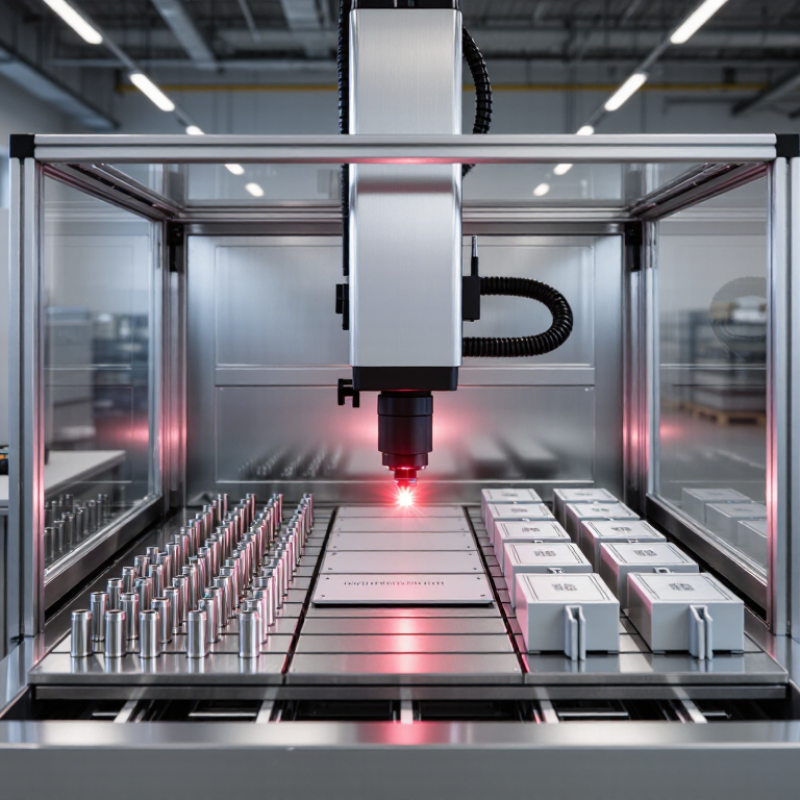
A Large Format Batch Laser Marker can change how manufacturers handle high-volume identification. Instead of marking one component at a time, it processes several parts within one working field. A tray may hold dozens of stainless-steel fittings, aluminum panels, or molded plastic housings. Each part can receive a serial number, QR code, logo, or production date. This reduces repeated loading and saves valuable operator time.

Professor Stefan Nolte, a recognized laser-processing researcher, emphasizes, “Reliable laser processing depends on controlled energy delivery, not power alone.” That principle matters here. A large marking field needs stable focus, accurate positioning, and consistent software control. A powerful source alone cannot correct poor fixture design or uneven part heights. In real production, small errors become expensive quickly.

The practical advantage is consistency. A well-designed system can mark an entire fixture before the next batch arrives. Operators spend less time opening doors, aligning parts, and checking individual positions. Traceability also becomes easier when every code follows the same digital template. However, larger is not automatically better. Very small parts may lose detail across a wide field, and complex fixtures can increase setup time. That trade-off deserves honest testing.

Factories should examine sample materials, marking speed, code readability, fume extraction, and maintenance access before purchasing. A short trial often reveals problems that brochures hide. The best Large Format Batch Laser Marker is not simply the fastest machine. It is the system that delivers readable marks, repeatable placement, and dependable output during ordinary production pressure. Reliability is built on details. Sometimes, those details are overlooked.
Why Choose a Large Format Batch Laser Marker?

Large-Format Marking Fields: 100 × 100 to 600 × 600 mm

Why Choose a Large Format Batch Laser Marker?

A 100 × 100 mm field suits compact parts and tightly controlled marking zones. A 600 × 600 mm field can cover panels, trays, or multiple components in one cycle. This wider area reduces repositioning, clamping changes, and alignment checks during batch production. It also makes layout planning more flexible. Fit matters more.

Grand View Research valued the global laser marking machine market at about USD 3.1 billion in 2023. Its report expects an approximately 8.5% compound annual growth rate through 2030. Fortune Business Insights also forecasts strong expansion, although its market estimate differs. These differences deserve attention. Report boundaries and equipment categories are not always identical.

Large-format systems can improve throughput, but field size alone does not guarantee better marks. Galvanometer accuracy, lens design, focus consistency, and thermal control become more demanding near the field edges. A test on a 600 × 600 mm plate may reveal slight size variation or softer line quality. That is normal, but it should not be ignored. In practical trials, engineers should compare center and corner samples, then measure contrast, dimensional accuracy, and cycle time. A 100 × 100 mm setting may still deliver cleaner results for small precision parts. The best choice depends on batch geometry, not impressive specifications.

Why Choose a Large Format Batch Laser Marker?

Large-format marking fields support batch processing of multiple parts or larger workpieces in a single setup. The chart compares square marking fields from 100 × 100 mm to 600 × 600 mm.

The marking area is calculated as width × height. A 600 × 600 mm field provides 36 times the area of a 100 × 100 mm field, helping accommodate larger parts or more components per batch.

Batch Throughput Metrics: Processing 10,000+ Parts per Shift

Why Choose a Large Format Batch Laser Marker?

Processing 10,000 parts per shift demands more than a fast laser source. An eight-hour shift allows only 2.88 seconds per part, including loading, marking, verification, and unloading. A large format batch laser marker can process multiple components in one fixture, reducing repeated operator movements and indexing delays. With 20 parts marked per cycle, the target becomes 500 cycles per shift. That calculation is clearer, but real production is rarely perfect.

Throughput should be measured as good, verified parts per shift, not theoretical marks per hour. ISO 22400 recommends tracking manufacturing performance through standardized KPIs, including availability, performance, and quality. An 85% OEE target is commonly treated as a world-class benchmark, although many factories achieve less during changeovers or maintenance. At 85% effective availability, a line must produce approximately 11,765 parts to deliver 10,000 acceptable parts.

Deloitte’s 2023 Smart Manufacturing and Operations Survey found that 86% of manufacturing leaders expect smart manufacturing to become a major competitiveness factor within three years. Automated vision checks, recipe control, and traceable job data support that direction. The International Federation of Robotics reported 541,302 industrial robot installations worldwide in 2023, showing continued investment in automated production.

Still, large-format marking is not automatically faster. Poor fixturing, uneven surfaces, and slow data transfer can erase the advantage. Measure cycle time at the workstation. Include rejects, cleaning, and changeovers. The uncomfortable number is usually the useful one.

Laser Power Selection: 20–100 W for Faster Cycle Times

A large format batch laser marker becomes valuable when many parts share one work area. Its wider field can reduce repositioning, handling, and alignment time. Laser power strongly affects how quickly each batch moves through production. A 20 W source often suits thin coatings, labels, and low-contrast identification. It produces controlled marks with limited heat buildup. At 50 W, deeper marks and shorter exposure times become more practical. Higher power is not automatically better. That matters.

A 100 W system may complete dense codes faster on metal or hard surfaces. It can also support larger batches with fewer pauses between marking cycles. However, excessive power may discolor surfaces, widen the mark, or damage delicate finishes. Technicians should test several settings before choosing a production value. Compare mark speed, readability, depth, and surface temperature. Small details change everything. On-site trials reveal more than a specification sheet.

Reliable selection depends on measured cycle times, not claimed maximum speed. Record laser-on time, loading time, and cooling intervals separately. Check lens coverage across the full working area. Confirm that every position receives consistent contrast and focus. Proper guarding, ventilation, calibration, and operator training should remain part of the setup. I have seen teams focus on wattage and overlook material variation. The first estimate is often optimistic. A practical system should leave adjustment room for new batches, changing finishes, and occasional misalignment. Perhaps the best power level is not the highest one, but the one that stays stable throughout a demanding shift.

Precision and Traceability: ±0.01 mm Accuracy with Serialized Codes

Why Choose a Large Format Batch Laser Marker?

A large format batch laser marker keeps multiple parts positioned within one working area. This reduces repeated loading and supports faster, more consistent production. Its key value appears in precision and traceability. With proper calibration, marking accuracy can reach ±0.01 mm for demanding identification tasks. Each serialized code can record a part’s lot, operator, date, or inspection status.

Small details matter. A fixture should hold every component firmly, without covering the marking zone. Focus distance must remain stable across the full work area. Dust, vibration, and heat can still affect results. In production, the first setup is rarely perfect. A practical operator checks test marks with a calibrated camera or measuring tool before releasing the batch.

Reliable traceability depends on more than sharp characters. Codes must remain readable after handling, coating, or assembly. A verification step can reject incomplete, duplicated, or poorly contrasted serial numbers. Software logs can connect each code with production records, making investigations faster and more defensible. Yet ±0.01 mm should not be treated as a universal promise. Material, lens selection, thermal drift, and machine calibration influence real performance. Regular verification remains essential. The overlooked check can become the expensive mistake.

Why Choose a Large Format Batch Laser Marker? - Precision and Traceability: ±0.01 mm Accuracy with Serialized Codes

Data Dimension Representative Value Operational Meaning Recommended Verification
Positioning accuracy ±0.01 mm Supports consistent placement of text, symbols, barcodes, and 2D codes across large work areas. Verify with a calibrated vision target, dimensional artifact, or coordinate-measuring system.
Marking method Non-contact laser marking Avoids tool wear and mechanical contact with the workpiece, helping protect delicate or finished surfaces. Inspect the marked surface for distortion, burrs, cracking, or unacceptable heat-affected areas.
Large-format marking area Up to approximately 300 × 300 mm per field, depending on optics Allows multiple parts, fixtures, or a larger component surface to be marked in one setup. Confirm field size, edge distortion, and accuracy at the center and corners of the work area.
Code types QR Code, Data Matrix, Code 128, Code 39, and human-readable text Provides flexible identification for components, packaging, tooling, and production batches. Scan samples using the same reader type and lighting used on the production line.
Serialized identification Unique serial number for every part or batch Reduces duplicate-code risk and links each item to manufacturing, inspection, and shipment records. Use sequence control, duplicate detection, and a database or manufacturing execution system.
Typical serialized data fields Part number, serial number, lot, date, shift, and inspection status Creates a compact, machine-readable record for process and after-sales traceability. Define a fixed data structure and validate each field before marking begins.
Batch workflow Multi-part fixture or indexed positioning Enables repeated marking of several workpieces with a controlled location and sequence. Check fixture datum points, part orientation, indexing repeatability, and batch completion records.
Material compatibility Metals, selected plastics, coated parts, ceramics, and painted surfaces Laser wavelength, power, pulse settings, and surface treatment must be matched to the material. Run a material test matrix covering contrast, permanence, cycle time, and surface damage.
Code readability Target: stable decoding under production lighting and scanner conditions Reliable readability supports automated inspection and reduces manual data-entry errors. Evaluate symbol contrast, quiet zones, cell geometry, and grading against the applicable barcode standard.
Data connection Ethernet, digital I/O, or production-system interface Allows job selection, serial-number control, start confirmation, and marking-result feedback. Test handshaking, timeout behavior, error handling, and record synchronization.
Traceability record Code-to-part relationship with timestamp and process result Creates an auditable history for quality review, recalls, warranty analysis, and compliance documentation. Perform database reconciliation between generated codes, scanned codes, and completed production records.
Quality control frequency Start-of-shift, job-change, and periodic in-process checks Helps identify focus drift, fixture movement, contamination, and code-quality changes before a full batch is affected. Document inspection frequency, acceptance limits, sample size, and corrective-action rules.

Note: Actual accuracy, marking field, speed, and material performance depend on the laser source, optics, workpiece, fixture, environmental conditions, and process settings.

Operating Economics: 100,000-Hour Sources and Minimal Consumables

Why Choose a Large Format Batch Laser Marker?

Operating economics often begin with the laser source, not the purchase price. Many industrial fiber-source specifications list lifetimes of up to 100,000 hours. That figure is a rating, not a promise. Dust, heat, unstable power, and poor maintenance can shorten it. In a clean, temperature-controlled line, however, the source can operate for years with minimal intervention.

LOW CONSUMABLE USE No ink cartridges. No solvent storage. No routine nozzle replacement.

This matters on large batch work. A single marker can process wide panels, grouped components, or several parts in one fixture. The machine spends less time repositioning. The International Federation of Robotics recorded 541,302 industrial robot installations worldwide in 2023, showing how strongly factories are investing in automated handling. A large-format marker can fit naturally into that environment, especially when its software supports barcode reading and automatic job selection.

The savings are measurable. Consider a line running 4,000 parts daily. Removing even one consumable change each shift can recover minutes, labor, and production space. The U.S. Department of Energy’s Industrial Decarbonization Roadmap also identifies energy efficiency as a practical industrial priority.

Laser marking usually creates little process waste, but electricity, extraction, and idle time still matter. My calculation would not ignore those costs. The spreadsheet is never the whole factory. Verify the source rating, scan speed, cooling needs, and real batch samples before buying.

FAQS

How many parts can a large format batch laser marker process per shift?

A target of 10,000 good parts requires more than speed.

Should throughput be measured by marks per hour?

No. Measure verified, acceptable parts per shift.

How does multi-part fixturing improve production?

One fixture holds several components inside the marking area.

What affects the real cycle time?

Loading, marking, vision checks, unloading, and data transfer all matter.

Can marking accuracy reach ±0.01 mm?

It can under suitable conditions and careful calibration.

How should parts remain stable during marking?

Use a rigid fixture that holds every component firmly.

What information can serialized codes record?

Codes can identify a part lot, operator, production date, or inspection status.

How can code quality be verified?

Use a calibrated camera or measuring tool to inspect test marks.

Conclusion

A Large Format Batch Laser Marker is designed for manufacturers that need to mark many parts quickly while maintaining consistent quality. With marking fields ranging from 100 × 100 mm to 600 × 600 mm, it can process larger components or multiple smaller parts in one cycle. Depending on material and application requirements, laser power from 20 to 100 W helps shorten cycle times and supports throughput of more than 10,000 parts per shift.

Beyond speed, this system provides reliable precision and traceability. Marking accuracy of up to ±0.01 mm enables clear, repeatable results, while serialized codes support efficient identification, production tracking, and quality control. Its long-life laser source, rated for up to 100,000 hours, reduces replacement frequency and operating interruptions. With minimal consumables and limited routine maintenance, a Large Format Batch Laser Marker can lower long-term operating costs while improving productivity, consistency, and production flexibility.

Clara Bennett

Clara Bennett

Clara Bennett is a professional marketing specialist with a strong understanding of the company’s products, their practical applications, and the needs they are designed to address. She regularly contributes expert articles to the company website, translating product knowledge into clear, useful......