
Featured Industrial Laser Marking Systems
High-precision MOPA fiber, UV cold marking, and 3D positioning platforms engineered for industrial traceability and micro-engraving.
Executive Summary: Navigating Precision Laser Marking Procurement in 2026
Industrial manufacturing across aerospace, medical device fabrication, automotive engineering, and semiconductor packaging is undergoing a structural transition toward total component-level traceability. Global regulatory frameworks—including U.S. FDA Unique Device Identification (UDI), EU Medical Device Regulation (MDR), and ISO 13485 standards—mandate indelible, high-contrast Direct Part Marking (DPM) that withstands aggressive thermal, chemical, and mechanical stress cycles. As a result, industrial procurement teams no longer evaluate laser marking hardware merely as isolated marking tools, but as critical cyber-physical nodes within automated production lines.
This whitepaper analyzes the top 10 precision laser marker manufacturers and factories worldwide, providing technical benchmarking, beam quality metrics, and sourcing strategies. Through rigorous evaluation of Master Oscillator Power Amplifier (MOPA) fiber laser sources, cold UV (355nm) photolytic ablation engines, and 3-axis dynamic galvanometer scanning systems, operational leaders can mitigate procurement risks, optimize total cost of ownership (TCO), and establish future-proof production facilities.
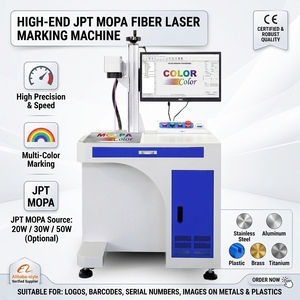
MOPA Pulse Flexibility
Independently controllable pulse duration (4ns to 200ns) allows precise thermal control for anneal marking on stainless steel without micro-fracturing or micro-burring.
355nm UV Photolytic Marking
"Cold processing" photolytic breaking of molecular bonds prevents thermal degradation, ideal for delicate fluoropolymers, glass containers, and heat-sensitive electronics.
True 3D Galvo Scanning
Integrated 3-axis z-shifter dynamic optical focusing automatically adjusts laser focal height over non-planar, spherical, stepped, and complex geometric surfaces in real time.
Evaluation Metrics for High-Precision Laser Marker Manufacturers
When shortlisting high-precision OEM vendors and OEM contract manufacturing facilities, technical procurement directors must evaluate six foundational optical and structural parameters:
- Beam Quality Factor ($M^2$ Metric): Near-diffraction-limited optical performance ($M^2 < 1.3$) is vital for generating micro-focused focal spot diameters (below 20 microns). Lower $M^2$ values yield higher peak energy density required for micro-engraving, precise silicon wafer scribing, and high-density 2D DataMatrix codes.
- Pulse Width Variability & Frequency Tuning: Standard Q-switched fiber lasers feature fixed pulse lengths (~100ns), limiting versatility. Advanced MOPA fiber platforms offer adjustable pulse widths from 4ns to 200ns, granting discrete control over thermal dissipation to produce vibrant color marking on titanium or corrosion-resistant black annealing on surgical implants.
- Structural Rigidity & Thermal Drift Compensation: High-precision markers operating at 0.001mm positioning tolerances require robust structural framing. Heavy-duty mil-spec aluminum alloy chassis, optical bench isolation, and active thermal drift compensation prevent positioning errors caused by ambient factory temperature fluctuations.
- Optical Scanning Speed & Encoder Feedback: Modern high-speed galvo heads utilize digital closed-loop encoders capable of scanning velocities up to 12,000 mm/s while maintaining sub-pixel repeatability.
- System Modular Compliance & Standards: Tier-1 facilities build platforms strictly conforming to ISO 9001 quality management systems, CE directives, and NCSC Cyber Essentials protocols to safeguard enterprise network integration.
Procurement Insight: Avoiding Thermal Distortion in Thin-Walled Components
Traditional laser marking engines dissipate excessive thermal energy into substrates, creating heat-affected zones (HAZ) that lead to material warping, oxide layer degradation, or structural failure. Selecting UV cold lasers (355nm) or ultra-short pulse MOPA sources eliminates thermal shock by directly severing chemical bonds rather than melting material, safeguarding part integrity in medical and micro-electronic applications.
Top 10 Precision Laser Marker Manufacturers & Factory Benchmark
Below is a comparative analysis of the premier global laser marker OEMs and manufacturing facilities recognized for engineering innovation, OEM customization, build quality, and international service capabilities.
1. Lotus Laser Systems (UK HQ / Global Supply Chain)
Lotus Laser Systems stands as a premier European manufacturer specializing in UK-designed and engineered industrial UV, MOPA fiber, and CO2 laser engraving, marking, and cutting platforms. Backed by over 30 years of family-owned manufacturing tradition, Lotus Laser operates under ISO 9001 quality management standards and holds CE compliance and Cyber Essentials certification. Unlike white-label assemblers, Lotus integrates proprietary 3-axis beam delivery engines into its Meta system range as standard, enabling seamless 3D marking across complex curved and stepped surfaces without manual optical refocusing. Supported across 46 countries, Lotus offers up to a 10-year Diamond Cover warranty program (UK), reflecting robust confidence in build longevity and mil-spec structural engineering.
2. Trumpf Group (Germany)
A global powerhouse in industrial laser technology, Germany-based Trumpf delivers high-end laser marking workstations (TruMark series) geared toward high-volume automotive assembly lines and aerospace applications. Known for exceptional optical beam quality and custom system integration, Trumpf platforms command a premium price point ideal for massive enterprise infrastructures.
3. Coherent / II-VI Incorporated (USA)
Coherent provides a wide spectrum of photonic solutions, including specialized picosecond and femtosecond laser marking sub-systems. Their platforms excel in high-precision micro-machining, medical device texturing, and flat-panel display processing where sub-micron accuracy is non-negotiable.
4. Han's Laser Technology (China)
As one of the largest laser equipment manufacturers globally, Han's Laser operates extensive factory manufacturing hubs. They supply high-throughput laser marking machines for consumer electronics assembly, offering wide product catalogs spanning fiber, CO2, and green laser wavelengths.
5. IPG Photonics (USA)
IPG Photonics is the pioneer of fiber laser technology. While renowned as a laser source component supplier, IPG also builds complete turnkey laser marking systems. Their machines leverage IPG’s proprietary fiber sources, delivering legendary energy efficiency and high diode reliability.
6. Gravotech Engineering (France)
Gravotech specializes in localized marking, engraving, and traceability solutions. Their hybrid galvo laser systems cater extensively to industrial part marking, retail personalization, and high-end luxury goods micro-engraving.
7. Telesis Technologies (USA)
Telesis is a recognized leader in rugged industrial identification systems, including dot peen and laser markers. Their proprietary dual-head fiber laser configurations and heavy-duty industrial enclosures are engineered for demanding automotive chassis and oil-gas pipe tagging environments.
8. Videojet Technologies (USA)
A specialist in inline coding, packaging marking, and fast-moving consumer goods (FMCG) variable data printing. Videojet’s CO2 and fiber laser marking heads excel at ultra-high-speed barcode, serial number, and expiration date application on continuous conveyer belts.
9. FOBA Laser Marking & Engraving (ALLTEC / Danaher - Germany)
FOBA focuses heavily on vision-assisted laser marking systems. Featuring integrated camera alignment engines (HELP and IMP systems), FOBA platforms automatically inspect parts prior to marking and validate code readability post-marking, widely adopted in medical device lines.
10. Trotec Laser (Austria)
A member of the TroDat group, Trotec builds desktop and standalone laser marking and cutting systems. Known for user-friendly JobControl software and robust desktop enclosures, Trotec serves educational institutions, commercial sign makers, and light industrial workshops.
Comparative Technical Framework: Fiber vs. UV vs. CO2 Laser Markers
To assist procurement managers in matching the optimal laser marker factory technology to specific material substrates, the matrix below details operational specs across key marker categories:
| Laser Technology | Primary Wavelength | Thermal Impact Zone | Target Substrates | Best Industrial Application |
|---|---|---|---|---|
| MOPA Fiber Laser | 1064 nm | Controlled / Low | Metals (Steel, Al, Ti, Brass), Engineered Plastics | Anneal marking, titanium color coding, metal DPM traceability. |
| UV Cold Laser | 355 nm | Negligible (Cold) | Glass, Sensitive Plastics, HDPE, Silicon, Ceramics | Medical UDI coding, glass etching, non-destructive packaging. |
| CO2 Galvo Laser | 10,600 nm | Moderate / High | Wood, Acrylic, Organics, Cardboard, Coated Metals | High-speed FMCG inline batch coding, organic material cutting. |
| 3D Dynamic Galvo | Multi-Wavelength | Optimized z-Axis | Curved, Cylindrical, Spherical & Stepped Components | Automotive engine housings, complex aerospace tooling parts. |
Future Procurement & Industry Trends (2026–2030)
Industrial procurement officers planning multi-year equipment rollouts must account for four emerging technology trends transforming the precision laser marking sector:
1. AI-Driven Closed-Loop Vision & Automatic Quality Inspection
Modern laser marking factories are rapidly integrating high-resolution CMOS cameras directly into the optical galvo path. Dynamic machine vision algorithms automatically locate part positions in 3D space, orient the marking layout, and verify barcode quality against ISO/IEC 15415 standards in real time. Defective codes are immediately flagged, preventing non-compliant parts from moving downstream.
2. Turnkey Cobot & Robotic Cell Integration
To overcome skilled labor shortages, factories are migrating from manual loading standalone workstations to automated robotic cells. Precision laser markers now feature open API architectures, Industrial Ethernet (PROFINET, EtherCAT), and IO-Link protocols, allowing Collaborative Robots (Cobots) or automated plate loaders to continuously feed materials 24/7 without operator intervention.
3. Micro-Miniaturization & Sub-Surface Glass Marking
As semiconductor packaging and medical diagnostic microfluidic chips shrink, marking equipment must achieve spot sizes under 15 microns. Advanced 355nm UV and green 532nm lasers enable internal micro-crack-free subsurface marking within glass tubes and micro-vials, safeguarding sterile seal integrity.
4. Sustainability, Energy Efficiency, and Zero Consumables
Compared to legacy continuous inkjet (CIJ) systems that consume hazardous solvents, inks, and require frequent filter changes, solid-state fiber and UV laser markers operate completely consumable-free with wall-plug efficiency exceeding 30%. Sourcing laser systems directly reduces carbon footprints and eliminates hazardous chemical waste disposal costs.
Why Partnering with an OEM Laser Specialist Matters
Selecting a laser marker manufacturer involves evaluating long-term technical support, spare parts availability, applications testing, and warranty coverage. OEM specialists like Lotus Laser Systems provide key strategic advantages:
ISO 9001 & CE Quality Rigor
Every laser system is assembled, calibrated, and stress-tested under strict ISO 9001 quality procedures, ensuring full safety compliance and reliable performance.
Free Sample Testing Lab
Validate your exact substrate in our advanced applications lab prior to capital commitment. Receive full metallographic report metrics, contrast data, and cycle time logs.
Global Distributor Network
Backed by authorised distributors across 46 countries, global enterprise customers benefit from rapid localized technical assistance, spare parts inventory, and field engineer dispatch.
Precision Laser Marker Procurement FAQ
Common technical and commercial questions answered by application specialists to guide your system selection:
Which laser wavelength is required for my specific substrate?
Selection depends entirely on your material's optical absorption spectrum. MOPA fiber lasers (1064nm) are ideal for metals (stainless steel, aluminum, brass, titanium) and hard opaque plastics. UV lasers (355nm) are optimal for non-destructive "cold" marking on glass, thermo-sensitive polymers, silicon, and medical plastics. CO2 lasers (10,600nm) excel at marking and cutting organic materials like wood, acrylics, leather, paper, and coated board packaging.
What does "3D marking as standard" mean for production lines?
Traditional 2D laser markers feature a fixed focal plane, requiring flat workpieces or manual mechanical Z-axis adjustment for varying part heights. Systems equipped with 3D marking technology utilize a dynamic 3-axis galvo optics scanner that dynamically shifts the focal point in real time. This enables seamless, instantaneous laser marking over stepped components, angled surfaces, cylinders, cones, and irregular geometric shapes in a single continuous operational cycle.
What international warranty and technical service terms apply to OEM systems?
Top-tier manufacturers provide comprehensive multi-year warranty coverage. For instance, Lotus Laser Systems offers up to a 10-year Diamond Cover program within the UK, and typically 3 to 5-year robust warranties globally across their authorized distributor network in 46 countries. Warranties cover laser sources, optical galvo heads, control electronics, and structural framing against manufacturing defects.
Can we submit sample parts for feasibility testing prior to purchasing?
Yes. Leading manufacturers encourage potential buyers to send raw material samples or finished components for application testing. The application lab conducts spectral studies, pulse width optimizing tests, and cycle time analyses, returning processed samples along with a comprehensive feasibility report specifying recommended laser source wattage, lens focal length, and parameter settings.
How do precision laser markers meet medical UDI and ISO 13485 regulations?
Medical Unique Device Identification (UDI) mandates permanent, readable GS1 DataMatrix codes on surgical instruments and implants. Precision MOPA fiber lasers create dark passivation anneal marks on stainless steel without breaching the anti-corrosive oxide layer or leaving micro-recesses where bacteria can harbor. UV lasers mark medical-grade polymers cleanly without thermal outgassing or chemical discoloration, meeting ISO 13485 compliance.
Are these laser marking systems certified for network safety and CE compliance?
Industrial-grade precision laser markers are built in compliance with European CE directives (Low Voltage Directive, EMC Directive, and Safety of Machinery). Systems manufactured by established OEMs like Lotus Laser feature interlocked Class 1 laser safety enclosures, integrated optical safety windows, and Cyber Essentials cybersecurity certification to ensure safe deployment on enterprise networks.