
Featured Industrial Laser Marking Machinery
Direct-from-factory laser equipment, MOPA color engravers, and 3D positioning systems optimized for the UAE industrial sector.
Precision Laser Marking Dynamics in the United Arab Emirates
The manufacturing and industrial landscape across the United Arab Emirates (UAE) is undergoing a historic transformation driven by the UAE National Strategy for Industry and Advanced Technology, widely known as "Operation 300bn". Spearheaded by the Ministry of Industry and Advanced Technology (MoIAT), this ambitious initiative aims to expand the industrial sector’s contribution to GDP to AED 300 billion by 2031. Central to this roadmap is the integration of Industry 4.0 methodologies, modernizing production plants in industrial hubs such as Khalifa Economic Zones Abu Dhabi (KIZAD), Jebel Ali Free Zone (JAFZA), Dubai Industrial City, and Sharjah Industrial Areas.
In this rapidly evolving ecosystem, precision laser marking machines have transitioned from optional marking equipment to mission-critical infrastructure. The strict implementation of the In-Country Value (ICV) program by major state enterprises—including Abu Dhabi National Oil Company (ADNOC), Emirates Global Aluminium (EGA), and Strata Manufacturing—mandates rigorous component traceability, digital serialisation, and standardized direct part marking (DPM). Industrial buyers, factory managers, and EPC contractors in Dubai, Abu Dhabi, and Sharjah are actively replacing ink-jet coders and mechanical stampers with advanced MOPA fiber, UV cold laser, and 3D dynamic galvo systems to comply with international aerospace (AS9100), defense (DEF STAN / MIL-STD), and medical packaging regulations.
Key Macro Trends Driving UAE Procurement Intent:
ADNOC & Energy Asset Traceability
Oilfield tubular goods (OCTG), high-pressure flanges, subsea valves, and drill bits operating in harsh saline Gulf conditions require high-contrast, non-corrosive deep laser etching capable of surviving sandstorms, temperatures exceeding 50°C, and exposure to H2S gases.
Luxury Precious Metals & DMCC Certification
Dubai’s designation as the "City of Gold" and the expansion of the Dubai Multi Commodities Centre (DMCC) mandate non-destructive micro-engraving for hallmark authentication, karat stamping, and serial coding on gold bars, luxury timepieces, and high-end jewelry with zero material loss.
Pharma & Food Packaging Compliance
MoIAT and ESMA regulations mandate 2D Data Matrix and GS1 barcode tracking on medical vials, cosmetics, and food containers. Cold UV lasers prevent thermal distortion on thin plastics such as HDPE, PET, and flexible films.
Laser Source Wavelengths: Fiber, MOPA, UV & CO2 Compared
Selecting the optimal laser marker for a Middle Eastern production line requires a comprehensive technical understanding of material absorption spectra, thermal dissipation properties, and galvo scanner dynamic performance. Operating machines in ambient room temperatures that frequently fluctuate requires optoelectronic components capable of maintaining focal stability and optical beam quality (M² < 1.4).
| Laser Technology | Wavelength | Primary Target Materials (UAE Specs) | Key Advantage & Operating Mechanism |
|---|---|---|---|
| Standard Q-Switched Fiber | 1064 nm | Carbon steel, stainless steel, brass, copper, hard plastics | High energy density per pulse; economical for standard part number serialisation and metal tags. |
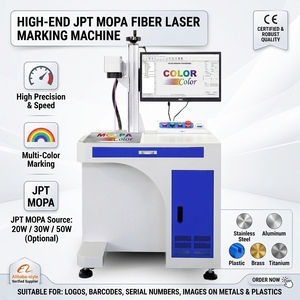
| JPT MOPA Fiber (M7/M8) | 1064 nm (Adjustable pulse: 1–500 ns) | Stainless steel, anodized aluminum, titanium, sensitive polymers | Variable pulse width permits color oxide marking on stainless steel, damage-free black marking on anodized aluminum, and precise annealing. |
| Cold UV Laser | 355 nm (Frequency-Tripled) | Glassware, medical grade silicone, heat-sensitive polymers, ceramic PCB | Photochemical "cold" processing breaks molecular bonds without heat generation, avoiding edge melting, micro-fractures, or thermal stress. |
| CO2 Galvo Laser | 10,600 nm / 9,300 nm | Wood, acrylics, organic leather, packaging paperboards, coated metals | High absorption coefficient for organic substrates; optimal for high-speed FMCG date coding and acrylic sign processing. |
Why MOPA Technology Dominates Stainless Steel & Aluminum Fabrication in UAE
Traditional Q-switched fiber lasers utilize a fixed pulse duration (typically ~100ns), which can induce micro-cracking and excess heat-affected zones (HAZ) on thin metals. By contrast, Master Oscillator Power Amplifier (MOPA) fiber laser sources (such as the JPT M7 MOPA series) empower process engineers to adjust pulse frequency (1 kHz to 4000 kHz) independently of pulse duration (1 ns to 500 ns). In UAE stainless steel architectural cladding projects and aluminum extrusion manufacturing (e.g., Emirates Aluminium profiles), MOPA technology yields deep, rich black anneals that resist atmospheric corrosion, salt spray, and UV fading without burning the surrounding substrate.
Localized Application Use-Cases Across Emirates
1. Oil & Gas / Offshore Subsea Equipment Marking (Abu Dhabi & Mussafah Industrial Area)
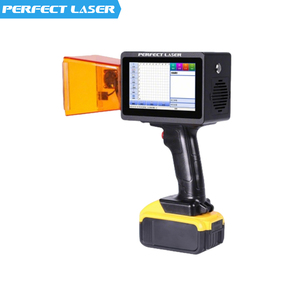
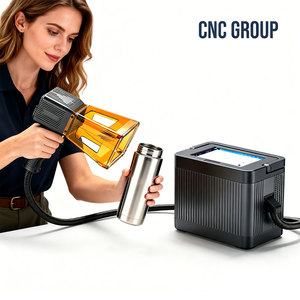
Equipment deployed in ADNOC offshore rigs or onshore processing units in Ruwais requires permanent identification tags to ensure 100% trace-ability over a 30-year lifecycle. Handheld and split-type fiber laser markers facilitate direct surface ablation on heavy 316L stainless steel, Inconel 625 alloys, and duplex steels. By engraving Data Matrix ECC200 codes down to depths of 100–200 microns, these marks remain legible even after severe surface oxidation, shot-peening, or application of heavy anti-corrosion marine paint coats.
2. Aerospace Components & Defense Hardware (Al Ain Aerospace Hub & Strata)
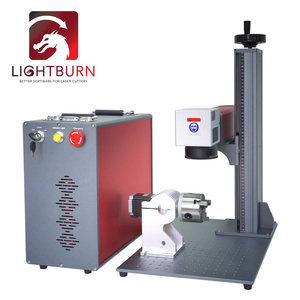
Aerospace manufacturing demands strictly controlled laser beam parameters to prevent micro-structural micro-fissures in titanium aerospace ribs and carbon-fiber composite panels. 3D dynamic focus laser markers utilize high-speed z-axis galvo optics, projecting a dynamic focal point across complex 3D contours, cylindrical surfaces, and compound angles in a single cycle—eliminating manual mechanical focal adjustment jigs.
3. Automotive VIN & Metal Fabrication (Dubai Industrial City & Sharjah Area 3)
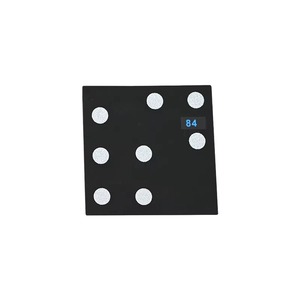
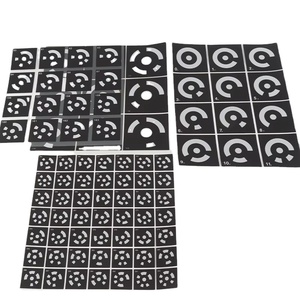
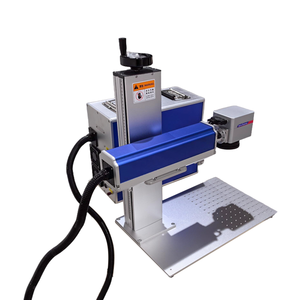
High-volume automotive body shops and localized trailer manufacturers utilize 50W to 100W split fiber laser units to etch Vehicle Identification Numbers (VIN) into vehicle chassis rails. Combined with optical retro-reflective 3D positioning target markers, handheld 3D laser scanners verify dimensional geometry while laser systems apply tamper-evident barcodes directly onto structural frames.
4. Electronics & Smart Meter Manufacturing (DEWA / SEWA Approved Suppliers)
Electric meters, smart grid junction boxes, and printed circuit board (PCB) assemblies fabricated for the Dubai Electricity and Water Authority (DEWA) demand sub-micron accuracy (0.001mm). UV laser markers excel at creating ultra-fine 0.5mm micro-text and high-density QR codes on flame-retardant ABS, polycarbonates, and ceramic substrates without thermal leakage into sensitive silicon chips.
Direct Factory Exporter Advantages for UAE Buyers
Procuring industrial equipment directly from an established manufacturing exporter eliminates intermediary markup costs while establishing a direct line of engineering support. Our manufacturing infrastructure is structured to address the specific importing, shipping, and climate challenges encountered by buyers in the Arabian Peninsula.
ISO 9001 & CE Certified Quality Control
Every laser machine undergoes 72 hours of continuous full-load burn-in optical stability testing, laser power power meter calibration, and galvo alignment checks prior to export packaging.
High-Ambient Thermal Engineering
Equipped with dual-stage thermo-electric cooling, IP54 dust-proof galvo optics, and heavy-duty industrial heat sinks engineered specifically for non-air-conditioned workshop environments in Middle Eastern summers.
Rapid GCC Logistics & Customs Clearance
Complete documentation packages provided for expedited customs clearance through Jebel Ali Port, Khalifa Port, or Dubai Cargo Village, including Certificate of Origin (COO), HS-Code declaration, and MoIAT compliance docs.
Frequently Asked Questions by UAE Industrial Procurement Managers
What laser wattage is required for deep metal engraving on oilfield valves?
For deep engraving (>0.2mm depth) on hard metals such as carbon steel or 316L stainless steel within acceptable cycle times, a 50W to 100W Fiber or MOPA laser machine is recommended. Higher power output delivers greater energy density per pulse, allowing rapid material vaporization without excessive thermal diffusion.
How do laser markers handle ambient summer temperatures up to 50°C in UAE workshops?
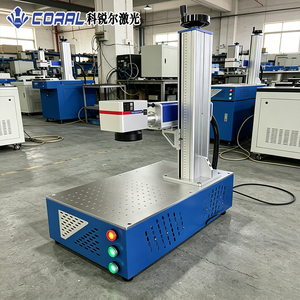
Our industrial split-type and enclosed workstations utilize high-efficiency air-cooling or integrated water chillers with sealed optical galvo heads (IP54 rating). This prevents dust particle accumulation on field lenses and maintains optical laser diode temperature within nominal operating ranges (15°C–35°C).
Can your laser machines print compliant GS1 Data Matrix codes for pharmaceuticals in Dubai?
Yes. The included software suite (EZCAD3 / LightBurn compatible) natively supports GS1 Data Matrix, QR Code, ECC200, and 1D Barcode algorithms. When combined with UV cold lasers, it produces sharp, high-contrast matrix codes that pass Grade A/B ISO/IEC 15415 verification scans on medical packaging.
What is the expected diode lifespan of a MOPA Fiber laser source?
Top-tier MOPA fiber laser sources (such as JPT M7/M8 series) carry an mean time between failures (MTBF) rating of 100,000 operational hours. Under typical 8-hour daily industrial operation, this translates to over 10 to 12 years of reliable service with zero gas consumables or lamp replacements.
How do I import laser machinery into UAE Free Zones (JAFZA, KIZAD, DAFZA)?
As direct factory exporters, we provide full shipping support (FOB, CIF, or DDP terms). We supply all required export paperwork—including commercial invoices, packing lists, Bill of Lading, and certified Country of Origin—ensuring smooth duty-free entry into UAE Free Zones or inland mainland declarations via Dubai Customs / Abu Dhabi Customs.
Can I request a sample testing report on my specific material before purchasing?
Absolutely. You can request a comprehensive material sample test. Send your sample parts to our applications laboratory; our engineers will perform test marks using Fiber, MOPA, UV, and CO2 wavelengths, providing a detailed report with high-resolution microscopy images, optimal parameter sets, and cycle time analysis.
Accelerate Your Manufacturing Quality in the UAE Market
Consult with our senior optical design engineers today. Receive a custom quote, technical datasheet, and complimentary sample testing tailored to your precise industrial requirements.
Send an Inquiry